sustainable agriculture

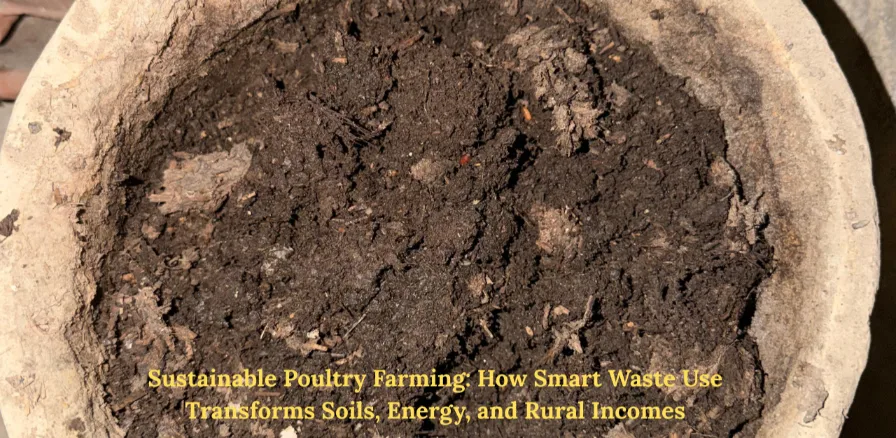
Sustainable poultry waste converted into organic compost in a clay pot, showcasing eco-friendly farming and soil improvement

Sustainable Poultry Farming: How Smart Waste Use Transforms Soils, Energy, and Rural Incomes

Sustainable Poultry Farming

Poultry production is expanding rapidly worldwide, and with it comes a growing stream of manure, litter, feathers, and processing residues that are often viewed only as a disposal problem rather than a strategic resource. When these wastes are managed poorly through open dumping, uncontrolled spreading, or discharge into water bodies they contribute to foul odors, disease risks, nutrient pollution, and greenhouse gas emissions that degrade the environment and harm nearby communities. Yet the same poultry waste, whether generated by small household flocks or large vaccinated commercial operations, contains high levels of organic matter and nutrients that can be transformed through controlled fermentation into biogas for energy and nutrient-rich digestate for soil improvement, supporting both environmental protection and local economic development.

 1 -Household poultry waste Vs vaccinated poultry waste

Household poultry waste usually comes from small backyard flocks and includes manure, bedding, feathers, spilled feed, and kitchen scraps mixed together. This waste stream is often unmanaged or simply dumped on soil, which can create odor, flies, and localized contamination if it accumulates.​

Vaccinated poultry waste mainly arises from commercial facilities and slaughterhouses where birds are regularly vaccinated and processed at scale. This waste is more concentrated, richer in proteins and fats, and often collected as sludge, guts, blood, and feathers, which makes it a high potential substrate for controlled anaerobic digestion but also a serious environmental risk if left untreated.​

From a fermentation point of view, vaccinated poultry waste is typically more homogeneous, has higher organic load, and is already centralized in processing plants, which makes it easier to feed into a biogas plant. Household poultry waste is more dispersed and variable, but it can still be co-digested with other organic materials (like kitchen waste or cattle manure) in community-scale digesters.​

This video shows the poultry waste gathered in a pot and after few days the culture develop and these microrganism ready to part in the fermentation process

2- Statistics of poultry production

Global poultry production has been growing steadily for years, with chicken meat output reaching over 95 million tons in 2018 and forecast to exceed 98 million tons in subsequent years. Major producers include the United States, Brazil, China, and the European Union, where demand for affordable meat and exports have driven expansion of industrial poultry systems.​

In the EU alone, exports of poultry products exceeded 1.8 million tons (carcass equivalent) in 2018, showing how integrated and large the poultry sector has become. This rapid growth translates directly into increasing volumes of manure, processing sludge, feathers, and other co-products that must be managed to avoid environmental damage and to capture their energy potential.​

For countries with fast-growing poultry sectors, such as Poland and many developing economies, poultry waste generation already represents a significant share of agricultural residues available for bioenergy. This creates both a challenge due to pollution risk and an opportunity to convert these residues into biogas and biofertilizers through fermentation (Cybulska et al., 2021).​

3- Environmental impact of poultry waste

Uncontrolled disposal of poultry waste leads to rancidity, spoilage, and uncontrolled decomposition, which releases foul odors, pathogens, and greenhouse gases such as methane and nitrous oxide. Landfills and open heaps of poultry residues can contaminate soil and water through nutrient leaching, as well as create public health concerns around insects, rodents, and disease transmission.​

High-protein wastes like slaughter sludge and droppings can generate significant amounts of ammonia and hydrogen sulfide under anaerobic conditions if not managed, which are toxic to both ecosystems and the microorganisms needed for stable biogas production. Excess nitrogen from these wastes may also disrupt fermentation and lead to process failure when not balanced with high-carbon co-substrates such as straw or plant residues.​

When poultry waste is diverted into well-designed biogas systems, the environmental load is reduced because organic matter is stabilized and emissions are controlled. Digestate from these systems can then be returned to the land as a nutrient source, closing the loop and reducing dependence on synthetic fertilizers while lowering overall pollution.​

4- Fermentation of poultry waste

Methane fermentation (anaerobic digestion) of poultry waste uses bacteria that work without oxygen to convert organic matter into biogas (mainly methane and carbon dioxide) and a stabilized digestate. Poultry processing sludge and manures are attractive substrates because they are rich in proteins and fats, which give high biogas potential when the process is properly controlled.​

In practice, poultry waste is often pre treated mechanically, chemically, or biologically before entering the digester to improve hydrolysis and reduce inhibitors. One effective approach is biological pre-treatment using specially selected bacterial strains that break down fats and proteins and reduce ammonia and hydrogen sulfide formation.​

Laboratory scale studies on centrifuged sludge from poultry processing have shown that optimizing the substrate with bacterial inocula can significantly increase both total biogas production and methane yield compared to untreated sludge. In the cited work, combinations of bacterial strains labeled AC and EG produced much higher methane yields than the control or mixed strain treatments.​

4- Stages of fermentation

The methane fermentation of poultry waste follows four main biological stages, all operating in parallel in the digester.​

  • Hydrolysis: Complex compounds such as proteins, fats, and polysaccharides are broken down by enzymes and water into simpler soluble molecules like amino acids, sugars, and long-chain fatty acids. This step is often rate-limiting for solid poultry residues and can be accelerated by pre-treatment or bioaugmentation.​
  • Acidogenesis: Acid-forming bacteria convert these soluble products into volatile fatty acids (VFAs) such as acetic, propionic, and butyric acids, along with gases like hydrogen and carbon dioxide. These acids lower pH and must be balanced to avoid inhibiting later stages.​
  • Acetogenesis: Specialized bacteria transform higher VFAs and alcohols into mainly acetic acid, hydrogen, and carbon dioxide, which are the key substrates for methane-forming microorganisms. Stability here depends on keeping hydrogen levels low and maintaining favorable pH and nutrient conditions.​
  • Methanogenesis: Methanogenic archaea convert acetic acid, hydrogen, and carbon dioxide into methane, completing the biogas production cycle. These organisms are particularly sensitive to temperature, pH, ammonia, and toxic compounds, so stable operating conditions are critical.​

Maintaining balance between these phases requires careful control of temperature, pH (typically around neutral), and carbon-to-nitrogen ratio, especially with nitrogen-rich poultry wastes. If ammonia levels become too high due to excess protein, methane production can drop sharply and the process may partially or fully collapse.​

5- Economical advantages of the fermentation for local commodity

For local communities, fermenting poultry waste delivers several economic benefits by generating energy, fertilizer, and new service opportunities. Biogas produced from poultry residues can be used for cooking, heating water, or generating electricity, reducing household and farm energy bills and lowering reliance on purchased LPG or grid power.​

Digestate from poultry waste fermentation is rich in nutrients such as nitrogen, phosphorus, and potassium, and can replace a portion of chemical fertilizers in nearby fields. Application of fermented products as fertilizers can increase crop yields by 7–15%, further boosting farm profitability (Zhang et al., 2023). This helps small farmers cut input costs, improve soil organic matter, and potentially increase yields all of which enhance local food security and income.​

On the enterprise side, poultry processors that introduce biogas systems can reduce their waste management fees and potentially sell excess electricity or biomethane, creating a new revenue stream. Treating sludge with optimized bacterial inocula has been shown to significantly improve methane yield, which increases the overall energy output and improves the economic viability of biogas plants.​

At the community level, decentralized digesters that codigest household poultry waste, kitchen waste, and other manures can support local jobs in operation, maintenance, and digestate marketing. Such bioenergy projects support circular economy goals, reduce environmental clean-up costs, and keep more value from the poultry supply chain within the local area instead of losing it through unmanaged waste disposal.

Citations

Cybulska, K., Kołosowska, I., Kramkowski, K., Karpińska, M., Roszkowicz-Ostrowska, K., & Kowalczyk, P. (2021). Improvement of biogas yield by pre-treating poultry waste with bacterial strains. Energies, 14(18), 5601. https://doi.org/10.3390/en14185601

Zhang, L., Ren, J., & Bai, W. (2023). A Review of Poultry Waste-to-Wealth: Technological Progress, Modeling and Simulation Studies, and Economic- Environmental and Social Sustainability. Sustainabilityhttps://doi.org/10.3390/su15075620.

Also checkout

Turning Landfill Liabilities into Liquid Gold — The Promise of Biomethanol Production
Sustainable Poultry Farming: How Smart Waste Use Transforms Soils, Energy, and Rural Incomes Read More »

Map of India highlighting Assam as a region for biomethanol production from rice straw to support rural clean energy and sustainability

Unlocking Rural India Clean Energy Future: Biomethanol from Rice Straw in Assam

Biomethanol from Rice Straw in Assam

India is at a crucial stage in its pursuit of sustainable growth, with clean energy solutions central to its development plans. Among the states, Assam shines due to its agricultural wealth and potential in renewable energy. This blog looks at how producing biomethanol from rice straw in Assam can transform rural energy systems, promote economic growth, and help India reach its clean energy goals.

Assam: The Green Heart of India Biomethanol Revolution

Agricultural Riches and Energy Challenges
Assam, located in Northeast India, is known for its rich fields and active agricultural sector. Almost half of its 78,438 square kilometers are cultivated, with rice as the main crop. Assam produces millions of tonnes of rice each year. However, this agricultural success leads to a significant by-product: rice straw. Often considered waste, rice straw is typically burned in open fields, causing severe air pollution and greenhouse gas emissions.

The Untapped Power of Rice Straw
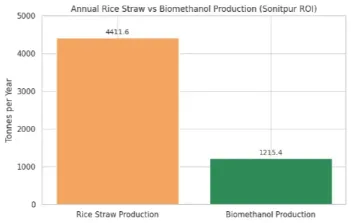
Rice straw availability: In areas like Sonitpur, Assam, studies show an annual surplus of over 4,400 tonnes of rice straw from just 5,480 hectares of farmland. This surplus is enough to produce more than 1,200 tonnes of biomethanol per year, or about 3.3 tonnes per day, from a single group of villages.
Statewide potential: When considering the entire state, Assam’s total rice straw resource is enormous, making it an ideal candidate for local bioenergy production.

Why Is It a Game Changer for Assam?

Biomethanol is a renewable fuel made from organic materials, such as agricultural waste. Unlike fossil methanol, derived from natural gas or coal, biomethanol is produced through the gasification of biomass, followed by cleaning the syngas and synthesizing methanol.

Why Biomethanol?

  • Clean-burning: Biomethanol burns cleaner than fossil fuels, significantly lowering emissions of CO2, NOx, SOx, and particulate matter.
  • Versatile applications: It can be mixed with gasoline, used as a feedstock in the chemical industry, or act as a hydrogen carrier for fuel cells.
  • Circular economy: Turning agricultural waste into valuable fuel exemplifies a circular bioeconomy.

The Science: How Biomethanol Is Made from Rice Straw in Assam

The Gasification Pathway

  1. Collection and Pre-treatment: Rice straw is gathered from fields, dried, and pre-treated to lower ash content and enhance its suitability for gasification.
  2. Gasification: The straw undergoes partial oxidation at high temperatures to produce a syngas rich in hydrogen and carbon monoxide.
  3. Syngas Cleaning: Impurities like tar, particulates, and sulfur compounds are removed.
  4. Methanol Synthesis: The cleaned syngas is then transformed into biomethanol using catalysts.

Technical Innovations for Assam Rice Straw
High Ash Content Solutions: Assam’s rice straw has an ash content of 9 to 22%, which can cause operational problems. Advanced pre-treatment methods, like alkali treatment, and the use of cyclone gasifiers help prevent slagging and corrosion, ensuring smooth operations.
Energy Efficiency: Conversion efficiencies of 40 to 43% can be achieved, yielding about 0.275 to 0.308 kg of biomethanol per kg of rice straw.

Environmental Benefits: Biomethanol vs. Open Burning

The Pollution Problem
Burning rice straw is a significant environmental challenge in Assam and across India. Each tonne of straw burned releases:

  • 1,460 kg of CO2
  • 60 kg of CO
  • 5.7 kg of CH4
  • 0.07 kg of N2O
  • Significant amounts of particulate matter, NOx, and SOx

Biomethanol’s Green Advantages

ROI( RETURN ON INVESTMENT) IN BIOMETHANOL PRODUCTION
  • Drastic Emissions Reduction: Biomethanol production from rice straw emits only 0.347 kg CO2e per kg of methanol, compared to 1,460 kg CO2 per tonne from burning.
  • Cleaner Combustion: It reduces NOx emissions by up to 80%, CO2 by 95%, and eliminates SOx emissions entirely.
  • Soil Health: It helps preserve beneficial soil microorganisms and maintains soil fertility, which is harmed by burning.

Economic Opportunity: Biomethanol as a Rural Game Changer in Assam

Feedstock Economics
Low cost resource: Delivered rice straw costs around INR 2.05/kg (USD 0.03/kg) for a 10 km transport, often less than the cost of burning or disposing of it.
Potential for negative cost: Farmers could be paid for providing straw, turning a disposal issue into a source of income.

Investment and Plant Economics

BAR CHART FOR RICE  STRAW PRODUCTION
  • Capital expenditure: A 50,000 tonne/year biomethanol plant requires a considerable investment, but costs decrease with size and government support.
  • Operational costs: These are heavily influenced by feedstock price and plant size, with economies of scale being essential for profitability.
  • Market prospects: The global biomethanol market is expanding quickly, with forecasts predicting high demand for sustainable fuels.

Government Support and Policy

  • Subsidies and incentives: The Indian government provides capital subsidies, for example, INR 15,000/kW for biomass gasification, and encourages second-generation biofuels through policy frameworks.
  • Carbon credits: The low carbon footprint of biomethanol can be monetized through carbon trading, increasing the project’s viability.

Socio Economic Impact: Empowering Rural Assam

Job Creation
Value chain employment: Biomethanol projects generate a variety of rural jobs, from straw collection and transport to plant operation and maintenance.
Skill development: New technical roles in bioenergy help develop skills and support rural industry.

Farmer Income Enhancement
New revenue streams: Commercializing rice straw gives farmers a stable, additional income, replacing the less profitable practice of burning or selling it at low value.
Case studies: Other regions have shown that farmers can earn up to INR 2,500 extra per season by selling straw for bioenergy.

Local Energy Security

  • Reduced fossil fuel dependence: Biomethanol production in Assam can help shield rural communities from unstable fossil fuel prices and supply disruptions.
  • Distributed generation: Decentralized plants near straw sources lower transport costs and ensure a reliable local energy supply.

Biomethanol and Assam: Aligning with India Clean Energy Vision

National Priorities

  • Methanol Economy Program: India’s initiative for a methanol economy aims to reduce crude oil imports, lower emissions, and improve rural incomes.
  • Biofuel blending targets: Government rules for ethanol and methanol blending in fuels boost demand for sustainable options like biomethanol.

Assam’s Strategic Advantage

  • Abundant feedstock: The consistent production of rice in Assam ensures a steady supply of straw, enabling year-round biomethanol production.
  • Policy alignment: Assam’s state policies and India’s national biofuel strategies are aligning to support bioenergy investments and rural development.

Overcoming Challenges: From Field to Fuel

Logistics and Supply Chain

  • Collection networks: Geographic Information System (GIS) technology helps map straw availability and create efficient supply chains, minimizing logistical costs.
  • Decentralized model: Smaller, distributed plants near sources of feedstock will optimize operations and cut transportation emissions.

Technical Barriers

  • Ash management: Innovations in pre-treatment and gasifier design tackle the high ash content of Assam’s rice straw, ensuring dependable plant operations.
  • Seasonal supply: Effective storage and planning are necessary to handle the seasonal availability of rice straw.

Financial Feasibility

  • Scale matters: Larger plants benefit from economies of scale, while using low-cost or negative-cost feedstock improves profit margins.
  • Multi-pronged strategy: Combining subsidies, carbon credits, and efficient logistics is crucial for making projects financially viable.

The Road Ahead: Strategic Recommendations for Assam

  • Promote decentralized biomethanol plants near rice straw clusters to maximize local benefits and reduce logistical challenges.
  • Invest in advanced pre-treatment and gasifier technologies to manage Assam’s unique feedstock characteristics.
  • Leverage government subsidies and carbon credits to improve financial returns and draw in investment.
  • Involve local communities and farmers to ensure a stable supply chain and fair economic benefits.
  • Integrate biomethanol into Assam’s clean energy plan, aligning with national biofuel goals and rural development objectives.

Conclusion: Biomethanol from Rice Straw in Assam

Assam is on the brink of a clean energy transformation. By harnessing biomethanol from rice straw, the state can turn an environmental problem into an economic advantage. This initiative will create rural jobs, boost farmer incomes, and contribute significantly to India’s net-zero goals. The journey from rice field to fuel tank unlocks Assam’s clean energy future while offering a model for sustainable rural development throughout India.

Biomethanol is not just a fuel; it is a catalyst for change, a driver of rural prosperity, and a key part of Assam’s path toward a greener, more resilient future.

Read our detailed insight on Biomethanol from Corn Straw in China: A Life Cycle Insight

Unlocking Rural India Clean Energy Future: Biomethanol from Rice Straw in Assam Read More »