Investing in Biomethanol: Stocks, Advanced Biofuels, and Market Trends
Investing in Biomethanol: Stocks, Advanced Biofuels, and Market Trends
In the global race to decarbonize energy and industry, a versatile, low-carbon fuel is rapidly moving from the niche laboratory to the industrial main stage: biomethanol. As an advanced biofuel derived from renewable resources like municipal waste, forestry residues, and industrial by-products, biomethanol is emerging as a critical component of the future energy mix. For the shrewd investor, this shift represents a compelling, yet complex, opportunity.
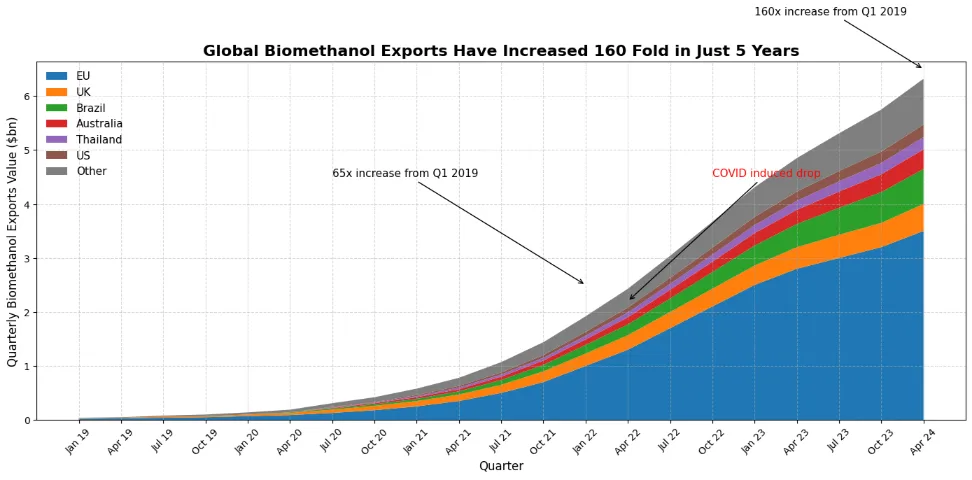
The global methanol market is expanding, with demand rising from 85.4 million metric tons in 2016 to over 110 million in 2021, and market value projected to exceed $55 billion by 2030. This growth is driven by investments in production infrastructure and increasing applications in transport, manufacturing, and chemicals. Biomethanol’s market share is expected to grow as carbon penalties on fossil fuels increase and as policy support for renewables strengthens (El-Araby, 2024).
1. Biomethanol Meets the Market
The methanol molecule is one of the world’s most vital industrial chemicals. Traditionally produced from natural gas or coal, its high-carbon footprint is now a major liability. Enter Biomethanol (also known as Renewable Methanol or Green Methanol), which is chemically identical but sourced through cleaner, circular processes, offering a reduction in emissions compared to its fossil fuel counterpart.
The Exponential Growth Trajectory
The market is currently in a high-growth phase. Recent forecasts project the global Bio Methanol Market, which was valued at under million in 2024, to surge to several billion dollars by 2034, reflecting a Compound Annual Growth Rate (CAGR) well over . This explosive growth is not speculative; it is driven by two powerful, interlocking forces: regulatory mandate and industrial necessity.
Key Market Drivers:
- Decarbonization of Shipping: The marine transport sector is the single biggest catalyst. With the International Maritime Organization (IMO) setting stringent greenhouse gas (GHG) reduction targets, major shipping lines (like Maersk) are committing to methanol-powered vessels. This shift alone creates a massive, long-term demand floor for renewable fuels.
- Circular Economy: Biomethanol’s primary feedstocks—municipal solid waste (MSW), agricultural residues, and biogenic —align perfectly with the circular economy model. By turning waste into valuable fuel, it solves both energy and waste management problems simultaneously.
- Chemical Feedstock Transition: In the chemical industry, biomethanol is replacing fossil-derived methanol in the production of formaldehyde, acetic acid, and various plastics, allowing downstream companies to meet their own sustainability pledges.
The message is clear: biomethanol is no longer a fringe concept; it is an industrial imperative.
2. Investment Landscape of Advanced Biofuels
Biomethanol sits within the broader Advanced Biofuels sector, a group of renewable fuels that do not rely on food crops (like corn or soy) for feedstock. This distinction is crucial for investor confidence and long-term sustainability.
Defining Advanced Biofuels
Unlike first-generation biofuels (e.g., corn ethanol), advanced biofuels, including biomethanol, Renewable Diesel (RD), and Sustainable Aviation Fuel (SAF), are superior due to:
- Feedstock Diversity: They use non-food-competitive sources (waste fats, municipal waste, agricultural residues).
- Lower Carbon Intensity: Their production and use result in significantly greater GHG reductions.
- High-Value Applications: They target “hard-to-abate” sectors like heavy-duty transportation, shipping, and aviation.
Policy as a Catalyst
The financial viability of advanced biofuels is heavily influenced by government policy, which acts as a powerful derisking factor for large-scale projects:
| Policy Mechanism | Global Impact | Relevance to Biomethanol |
| U.S. Inflation Reduction Act (IRA) | Generous tax credits for clean fuel production. | Provides significant production tax credits ( ) for low-carbon intensity fuels, directly boosting project economics. |
| European Green Deal / RED II | Mandatory blending obligations and emission targets. | Establishes firm targets for renewable energy in transport, creating guaranteed long-term demand and premium pricing for biomethanol. |
| IMO Decarbonization Rules | Global standards for maritime emissions. | Drives the massive order book for methanol-powered vessels, ensuring sustained demand from the shipping industry. |
For investors, a company’s ability to successfully navigate and leverage these regulatory frameworks is a key indicator of future profitability. The policy tailwinds for this sector are currently stronger than at any point in history.
3. Publicly Traded Companies
Investing in the biomethanol space often means looking beyond pure-play companies—which are frequently private startups—to established players who are strategically shifting their focus or forming high-value joint ventures.
Key Players and Investment Angles
While a pure “Biomethanol Stock” may be rare, investors can gain exposure through three distinct categories of publicly traded companies:
A. Methanol Majors and Diversified Giants
These companies are large chemical or energy firms with the capital and infrastructure to scale up biomethanol production rapidly.
- Methanex Corporation (MEOH): The world’s largest producer and supplier of methanol. While its core business is fossil-derived, its established global distribution, logistics, and trading network are essential for moving renewable methanol. Any major shift by Methanex into renewable production will dominate the supply landscape.
- OCI N.V. (OCI): A global producer of fertilizers and methanol. OCI is a significant player in the renewable segment through its BioMCN facility, one of the world’s largest renewable methanol producers. OCI offers a direct, scaled exposure to the bio-methanol value chain.
- BASF SE (BAS): A chemical giant that consumes and produces methanol. Its involvement is often focused on integrating green methanol into its vast downstream chemical operations, representing a stable demand side of the equation.
B. Advanced Biofuel Specialists and RNG Producers
These firms specialize in advanced conversion technologies, often working with the feedstocks that biomethanol requires (waste, biomass).
- Gevo, Inc. (GEVO): Focused on converting renewable resources into net-zero carbon fuels, including isobutanol and jet fuel, but the technological overlap (especially gasification and synthesis) with biomethanol production is significant. They represent a bet on innovative conversion technology.
- Enerkem (Private/Venture-backed but highly relevant): A key technology provider for waste-to-chemicals/fuels, including biomethanol. While not publicly traded on major exchanges, their partnerships and technology adoption by public companies should be closely watched.
- WasteFuel (Private/Venture-backed): Backed by major oil companies like bp, WasteFuel is explicitly focused on converting municipal and agricultural waste into bio-methanol for the shipping sector. Watch for potential IPOs or partnerships with publicly listed companies.
C. Energy Majors and Off-takers
Major oil & gas companies and shipping lines are investing heavily to secure future supply.
- A.P. Moller – Maersk A/S (MAERSK-B.CO): The world’s leading container shipping company, which has ordered a fleet of methanol-fueled vessels. While not a producer, their massive and guaranteed off-take agreements with producers make them the ultimate bellwether for demand.
- bp plc (BP): Through its ventures arm, bp is actively investing in and partnering with biomethanol startups like WasteFuel, securing off-take rights to fuel its own decarbonization strategies.
4. Risks and Opportunities in the Biomethanol Space
While the tailwinds are strong, investing in this nascent sector requires a clear-eyed view of both the potential upside and the substantial risks.
Opportunities (The Upside)
| Opportunity | Description | Investor Takeaway |
| Scalable Technology | Conversion technologies (gasification, synthesis) are proven at an industrial scale, reducing technical risk compared to cutting-edge clean tech. | Focus on companies that can quickly replicate and scale their plant designs globally (modular construction). |
| Feedstock Security | The reliance on readily available waste streams (MSW, forestry residues) provides a lower and more stable feedstock cost base than food crops. | Look for companies with vertically integrated models that control their own waste supply chain. |
| Policy Premium | Strong government incentives, tax credits (IRA), and regulatory mandates create a “policy-driven margin” that insulates profitability from traditional energy price volatility. | Favor companies with projects in supportive regulatory environments (U.S., E.U.). |
| Shipping Decarbonization | The maritime sector’s immediate need for a scalable, green fuel is creating a demand shock that biomethanol is uniquely positioned to meet. | This demand is structural and long-term, suggesting high utilization rates for new production facilities. |
Risks (The Caution)
| Risk | Description | Investor Takeaway |
| High Capital Expenditure (CapEx) | Initial plant construction costs for advanced biofuel facilities remain very high, leading to significant project financing risk. | Watch for successful financial close of large projects and look for government loan guarantees (e.g., U.S. DOE) to mitigate this risk. |
| Policy Volatility | Changes in government mandates, withdrawal of tax credits, or shifts in credit valuation (e.g., RIN/LCSF pricing) can instantly erode profitability. | Diversify geographically to hedge against single-country policy changes. |
| Competition from e-Methanol | Biomethanol is not the only “green methanol.” E-methanol (produced from green hydrogen and captured ) is an emerging competitor. | Monitor the relative costs of green hydrogen versus biomass/waste, as this will determine the long-term cost leader. |
| Feedstock Pre-treatment | Turning highly variable waste (MSW) into uniform, stable syngas for methanol synthesis is technologically challenging and costly. | Research a company’s technological maturity in feedstock pre-treatment—this is often the weakest link in the value chain. |
Biomethanol can substantially reduce greenhouse gas emissions—up to 95% less CO₂ and 80% less NOx compared to fossil fuels making it attractive for climate targets and regulatory incentives, especially in transport and shipping sectors. Demand for low-carbon fuels is rising, with biomethanol positioned as a cost-competitive option in regions with strong policy support and carbon pricing (e.g., Sweden’s maritime sector)
Its use as a drop-in fuel and chemical feedstock broadens market applications (Harahap et al., 2023).
Biomethanol faces several challenges that limit its widespread adoption. Its production costs are 1.5 to 5 times higher than fossil-based methanol due to expensive feedstocks, complex processes, and significant capital investment. Securing sustainable biomass without conflicting with food production or causing land-use issues remains difficult. Additionally, unclear regulatory frameworks and slow permitting processes create market uncertainty that hinders investment. Technical obstacles such as scale-up difficulties, low conversion efficiencies, and safety requirements increase operational risks Deka et al. (2022). Furthermore, competition from emerging alternative fuels and volatile fossil fuel prices affect biomethanol’s market competitiveness.
5. Finally: Is Biomethanol the Next Big Bet?
For investors looking for a high-growth sector at the intersection of energy transition, circular economy, and industrial chemicals, biomethanol offers one of the most compelling narratives in the advanced biofuels space.
It is not a bet on an unproven technology, but a bet on the rapid commercialization and scale-up of known chemical processes applied to new, renewable feedstocks. The key difference between a successful investment and a struggling one will likely come down to three factors:
- Scale and Logistics: Can a company build, finance, and operate globally competitive facilities?
- Policy Capture: Is the company positioned to fully capitalize on lucrative government incentives like the IRA?
- Off-take Security: Does the company have long-term, secured contracts with major players in the shipping or chemical industries?
Biomethanol’s utility, especially in the hard-to-abate marine sector, secures its position as a necessity, not a luxury. While risks associated with CapEx and policy shifts exist, the robust, long-term demand driven by global decarbonization mandates suggests that yes, biomethanol is positioned to be a next big bet in the renewable energy investment landscape.
The industry is moving past the demonstration phase and into the deployment phase. The time for investors to begin their due diligence and position themselves in the companies best equipped to build the green fuel infrastructure of tomorrow is now.
Citations
El-Araby, R. (2024). Biofuel production: exploring renewable energy solutions for a greener future. Biotechnology for Biofuels and Bioproducts, 17. https://doi.org/10.1186/s13068-024-02571-9.
Harahap, F., Nurdiawati, A., Conti, D., Leduc, S., & Urban, F. (2023). Renewable marine fuel production for decarbonised maritime shipping: Pathways, policy measures and transition dynamics. Journal of Cleaner Production. https://doi.org/10.1016/j.jclepro.2023.137906.
Deka, T., Osman, A., Baruah, D., & Rooney, D. (2022). Methanol fuel production, utilization, and techno-economy: a review. Environmental Chemistry Letters, 20, 3525 – 3554. https://doi.org/10.1007/s10311-022-01485-y.
How Financial Support and Green Funds Can Accelerate the Scale-Up of Advanced Biofuel TechnologiesInvesting in Biomethanol: Stocks, Advanced Biofuels, and Market Trends Read More »