#Decarbonization

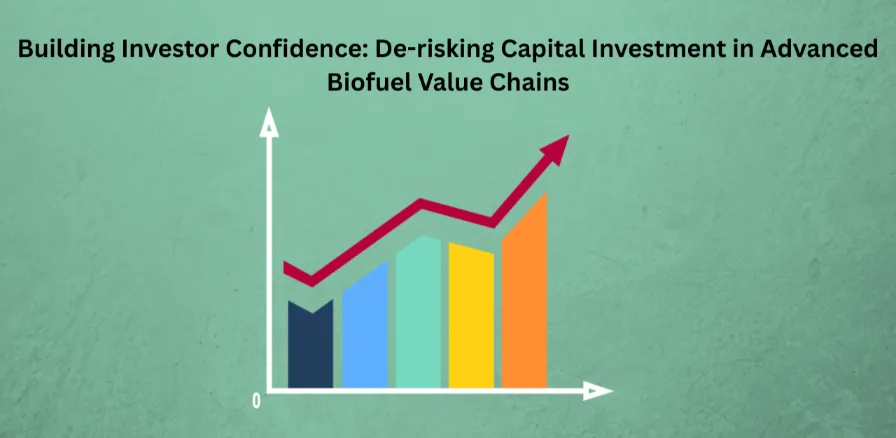
Graph illustrating growing investor confidence through de-risking capital investment in advanced biofuel value chains.

Building Investor Confidence: De risking Capital Investment in Advanced Biofuel Value Chains

De-risking Capital Investment: Building Investor Confidence in Advanced Biofuel Value Chains

The global push for decarbonization has put advanced biofuels in the spotlight as a crucial tool for a sustainable energy future. These next-generation fuels, derived from non food feedstocks like agricultural waste, algae, and forestry residues, offer a compelling alternative to fossil fuels. They don’t compete with food crops and have a significantly smaller carbon footprint, making them a more sustainable choice. However, despite their immense potential, the advanced biofuel sector has struggled to attract the scale of investment needed for widespread commercialization. Why? The simple answer is risk.

Investors, from private equity firms to venture capitalists, are wary of the technological and market uncertainties inherent in this nascent industry. They see a high risk, high capital landscape with unproven technologies and unpredictable policy environments. To unlock the trillions of dollars of capital required to build a robust advanced biofuel economy, we must systematically de risk the entire value chain. This isn’t just about building a plant; it’s about creating an ecosystem of confidence that benefits global markets and delivers a strong return on investment (ROI).

The Core Challenges: Understanding the Investor Mindset

Before we can build confidence, we must understand the sources of investor skepticism. The advanced biofuel value chain is complex, encompassing everything from feedstock sourcing to final fuel distribution. Each stage presents unique risks.

  • Technology Risk: Many advanced biofuel technologies are still in the demonstration or pilot phase. Investors fear that a promising lab scale process may not be economically viable or scalable for commercial production. There’s a concern about performance, reliability, and the potential for a “valley of death” where a technology fails to bridge the gap from R&D to commercial viability.
  • Feedstock Risk: A consistent and affordable supply of sustainable feedstock is the lifeblood of an advanced biofuel facility. Sourcing agricultural waste, municipal solid waste, or purpose grown energy crops at scale can be challenging due to seasonal variations, competition from other industries, and inconsistent quality. This creates significant supply chain volatility that directly impacts project economics.
  • Market Risk: The price of advanced biofuels is often tied to the volatile price of fossil fuels. Without robust, long-term policy support, a sudden drop in crude oil prices can make a biofuel project unprofitable overnight. Furthermore, the market for products like Sustainable Aviation Fuel (SAF) is still developing, and demand can be unpredictable.
  • Policy and Regulatory Risk: This is perhaps the most significant barrier. Government policies, such as blending mandates, tax credits, and carbon pricing mechanisms, are critical for making advanced biofuels competitive. However, frequent changes or a lack of long term policy stability can spook investors. They need a predictable regulatory environment to justify large, multi-decade investments.

De-risking the Value Chain: Strategies for Success

Building investor confidence is a multi faceted endeavor that requires collaboration between technology developers, governments, and financial institutions. By addressing each risk category head-on, we can transform the perception of the advanced biofuel sector from a high-risk gamble to a strategic, profitable investment.

1. Mitigating Technology and Execution Risk

The “valley of death” can be bridged with a combination of robust R&D and strategic partnerships.

  • Pilot and Demonstration Plants: Public private partnerships and government grants for pilot and demonstration facilities are crucial. These projects prove the technology at a larger scale, validate the process economics, and provide crucial operational data. This data is the gold standard for attracting private capital for full scale commercial plants.
  • Integrated Biorefineries: The future of advanced biofuels isn’t just about producing fuel. It’s about creating integrated biorefineries that produce a range of co products, such as bioplastics, chemicals, and power. This diversification of revenue streams insulates the project from fuel price volatility and enhances profitability, making it a more attractive investment.
  • Technological Standardization: As certain conversion technologies mature, developing industry wide standards for production processes and fuel specifications can lower perceived risk. This allows for easier due diligence and comparison for investors.

2. Stabilizing the Supply Chain and Feedstock Sourcing

Securing a consistent and cost effective feedstock supply is fundamental to project success.

  • Long-Term Offtake Agreements: Project developers must secure long term, multi year contracts with feedstock suppliers. These agreements, often with fixed or predictable pricing mechanisms, provide a stable foundation for the business model.
  • Diversified Feedstock Portfolio: Relying on a single feedstock is a significant risk. Companies that can process a variety of feedstocks—from agricultural residues to municipal waste are more resilient to supply disruptions and price fluctuations.
  • Digital Supply Chain Management: Leveraging technology to track feedstock availability, quality, and logistics can optimize the supply chain and reduce operational uncertainty. Blockchain and other digital tools can be used to ensure the sustainability and origin of the feedstock, adding a layer of trust.

3. Building a Resilient Market and Financial Framework

Creating a robust market for advanced biofuels is paramount to driving investment.

  • Carbon Pricing Mechanisms: Implementing a clear and stable price on carbon, either through a carbon tax or an emissions trading system, is one of the most effective ways to make advanced biofuels economically competitive. When polluters have to pay for their emissions, the value of a low-carbon fuel increases.
  • Blending Mandates and Credits: Long-term, binding blending mandates (like the U.S. Renewable Fuel Standard or EU’s Renewable Energy Directive) provide a guaranteed market for advanced biofuels. Credit markets, such as the market for Renewable Identification Numbers (RINs) or credits under the Clean Fuel Standard, provide a financial incentive that can be factored into a project’s ROI calculation.
  • Public-Private Financial Instruments: Governments can use a variety of financial tools to lower risk for private investors. This includes loan guarantees, tax credits for capital investment, and direct grants for project development. These instruments don’t just provide capital; they signal strong government commitment to the industry, which is a powerful confidence builder.

The ROI Equation: A Profitable and Purpose Driven Investment

Investing in advanced biofuels isn’t just a feel good choice; it’s a smart business decision with a compelling ROI. While individual project returns can vary widely based on technology, location, and market conditions, a strategic approach can yield significant financial benefits.

  • Potential for High ROI: While traditional first generation biofuel projects might see an ROI in the mid-single digits, advanced biofuel projects, when de risked and optimized, can generate significantly higher returns. With a stable policy environment and efficient operations, a project can potentially achieve an ROI of 15% to 25% or even higher. This is driven by several factors:
    • Higher Margins: Advanced biofuels often command a price premium due to their lower carbon intensity and the high demand in hard-to-abate sectors like aviation (SAF).
    • Co-product Revenue: As mentioned, the sale of high value co-products like bioplastics or renewable chemicals can create additional revenue streams that boost overall profitability.
    • Carbon Credit Monetization: The ability to generate and sell carbon credits provides a valuable, non-volatile revenue source that enhances the project’s financial stability.
  • Global Market Benefits: Beyond the individual project ROI, de-risking advanced biofuel value chains has massive benefits for the global economy.
    • Energy Security: It reduces reliance on volatile fossil fuel markets and strengthens domestic energy independence.
    • Rural Economic Development: Biofuel facilities create jobs in rural and agricultural communities, from feedstock harvesting and transportation to plant operations.
    • Environmental Impact: It directly contributes to global climate goals by reducing greenhouse gas emissions in the transportation sector, a major source of carbon.

Conclusion: A New Era of Sustainable Investment

The advanced biofuel industry is on the cusp of a major transformation. The challenges of high capital costs and technological uncertainty are real, but they are not insurmountable. By embracing a holistic strategy of de-risking the entire value chain through a combination of technological maturity, stable supply chains, and robust policy frameworks we can unlock the immense potential of this sector.

For investors, this new era presents a unique opportunity to align their portfolios with the global transition to a sustainable economy. By supporting projects that not only promise a solid ROI but also contribute to a cleaner, more secure energy future, we are not just making a wise financial decision; we are helping to build the world of tomorrow. The time to invest is now, as the seeds of a new, profitable, and purpose driven energy landscape are ready to grow.

Building Investor Confidence: De-Risking Capital Investment in Advanced Biofuel Value Chains
Building Investor Confidence: De risking Capital Investment in Advanced Biofuel Value Chains Read More »
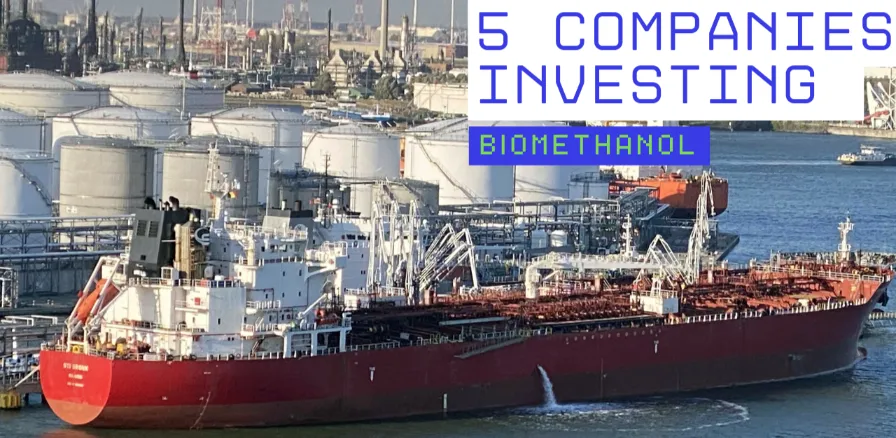
A large red and white oil or chemical tanker ship is docked, likely taking on or offloading cargo, with a massive industrial storage tank facility visible in the background under a blue sky. Overlaying text reads "5 COMPANIES INVESTING BIOMETHANOL."

5 Companies Investing in the Biomethanol

5 Companies Investing in the Biomethanol

Biomethanol is rapidly gaining traction as a sustainable alternative to fossil fuels, offering significant potential to decarbonize industries that have traditionally been hard to abate. Several leading companies are making strategic investments in biomethanol production and technology, recognizing its role in the global energy transition.

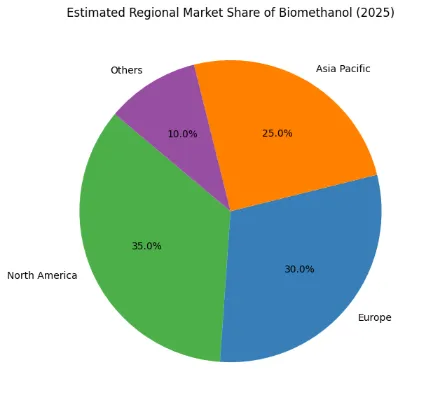
Pie Chart of Regional Market Shares of Biomethanol 2025

1. British Petroleum (BP)

This article explores five key companies British Petroleum (BP), Maersk, WasteFuel, M2X Energy, and Glocal Greenthat are pioneering investments and innovations in biomethanol to transform energy and industrial landscapes.

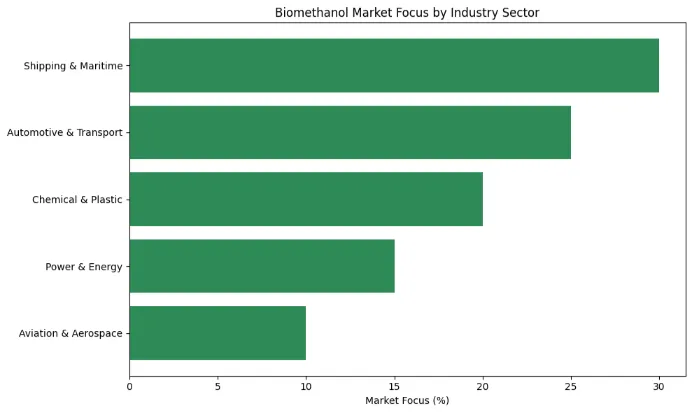
Bar Chart of Market focus on Biomethanol by industry sector

BP is one of the most prominent energy companies actively investing in biomethanol as part of its broader strategy to become an integrated energy company with net-zero ambitions by 2050. BP’s commitment to bioenergy is highlighted by its recent $10 million investment in WasteFuel, a California-based biofuels company specializing in converting municipal and agricultural waste into bio-methanol.

BP’s investment is a significant milestone in scaling biomethanol production and integrating it into global energy markets. By focusing on converting waste into low-carbon fuels, BP is addressing both waste management challenges and decarbonization goals, especially in hard-to-abate sectors like maritime shipping.

2. Maersk

Maersk, the world’s largest container shipping company, has been at the forefront of adopting alternative fuels to reduce its carbon footprint. Recognizing the potential of biomethanol as a marine fuel, Maersk has invested heavily in methanol-powered vessels and secured long-term supply agreements to support its decarbonization targets.

Shipping accounts for approximately 90% of global trade and contributes significantly to global emissions. Maersk’s commitment to biomethanol fuels demonstrates the shipping industry’s shift toward sustainable fuel alternatives that are compatible with existing engine technologies and infrastructure.

3. WasteFuel

WasteFuel is a pioneering biofuels company focused on converting municipal and agricultural waste into bio-methanol using proven anaerobic digestion and methanol production technologies. The company’s innovative approach addresses two critical challenges: managing growing global waste volumes and providing low-carbon fuel alternatives.

WasteFuel’s bio-methanol production is positioned to play a vital role in decarbonizing hard-to-abate sectors such as shipping, where electrification is challenging. The company’s projects contribute to reducing global greenhouse gas emissions by offering a renewable, scalable fuel solution.

4. M2X Energy

M2X Energy is an emerging player in the biomethanol sector, focusing on the development and commercialization of renewable methanol production technologies. The company leverages advanced catalytic processes and renewable feedstocks to produce biomethanol with a low carbon footprint.

By focusing on flexible production technologies, M2X Energy supports the decentralization of biomethanol production, enabling local and regional supply chains. This approach helps reduce transportation emissions and supports energy security while advancing the circular economy.

5. Glocal Green

Glocal Green is a clean energy company dedicated to producing sustainable biofuels, including biomethanol, from renewable resources. The company integrates biomass conversion technologies with innovative process optimization to deliver low-carbon fuels for industrial and transportation sectors.

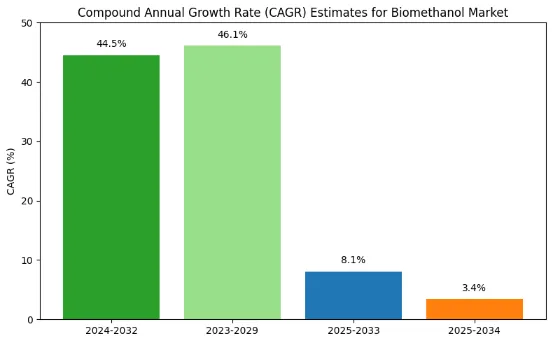
Bar chart of Estimates of CAGR for Biomethanol Market

Glocal Green is expanding its footprint by targeting emerging markets with abundant biomass resources, aiming to create sustainable energy ecosystems. Its investments in biomethanol production align with global climate goals and growing demand for renewable fuels.

Conclusion

The transition to a low-carbon future requires innovative solutions and strategic investments across industries. Biomethanol, with its versatility as a fuel and chemical feedstock, is becoming a critical component of this transition. Companies like BP, Maersk, WasteFuel, M2X Energy, and Glocal Green are leading the way by investing in biomethanol technologies and infrastructure that promise to reduce emissions, utilize waste resources, and support sustainable economic growth.

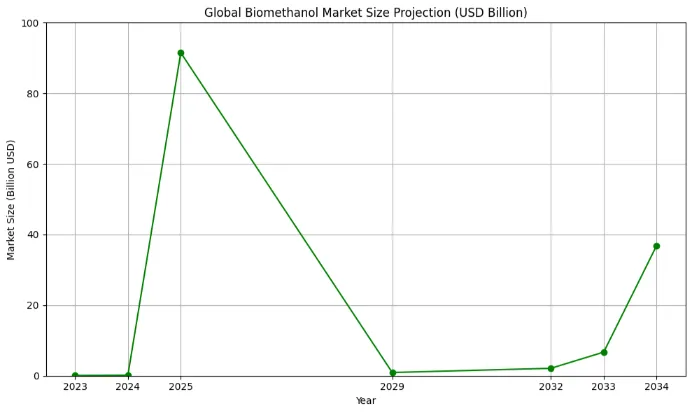
Global market Size Projection

BP’s significant investment in WasteFuel exemplifies how large energy companies are embracing biomethanol to decarbonize shipping and other hard-to-abate sectors. Maersk’s fleet expansion reflects the shipping industry’s commitment to cleaner fuels. Meanwhile, innovators like WasteFuel, M2X Energy, and Glocal Green are advancing the technology and production capacity needed to scale biomethanol globally.

Together, these companies are not only transforming their own operations but also catalyzing a broader shift toward sustainable energy systems worldwide. As biomethanol production scales and supply chains mature, its role in achieving global climate targets will only grow stronger.

Investing in Biomethanol Stocks — Advanced Biofuels and Market Trends

5 Companies Investing in the Biomethanol Read More »

An industrial chemical processing or refinery plant with tall cooling towers and complex pipework is silhouetted against a dramatic sunset or sunrise sky with orange and blue clouds. Overlaying text reads "5 INDUSTRIES THAT COULD BE TRANSFORMED BY BIOMETHANOL."

5 Industries that could be Transformed by Biomethanol

5 Industries that could be Transformed by Biomethanol

Biomethanol, a renewable variant of methanol, is rapidly emerging as a cornerstone in the global transition to sustainable energy and chemical production. Unlike conventional methanol, which is primarily derived from fossil resources such as natural gas, biomethanol is produced from biomass feedstocks ranging from agricultural residues and municipal solid waste to carbon dioxide captured from industrial processes.

With the chemical formula CH₃OH, methanol is a light, colorless, and biodegradable liquid that is highly soluble in water and widely used as a chemical feedstock, fuel, and energy carrier.

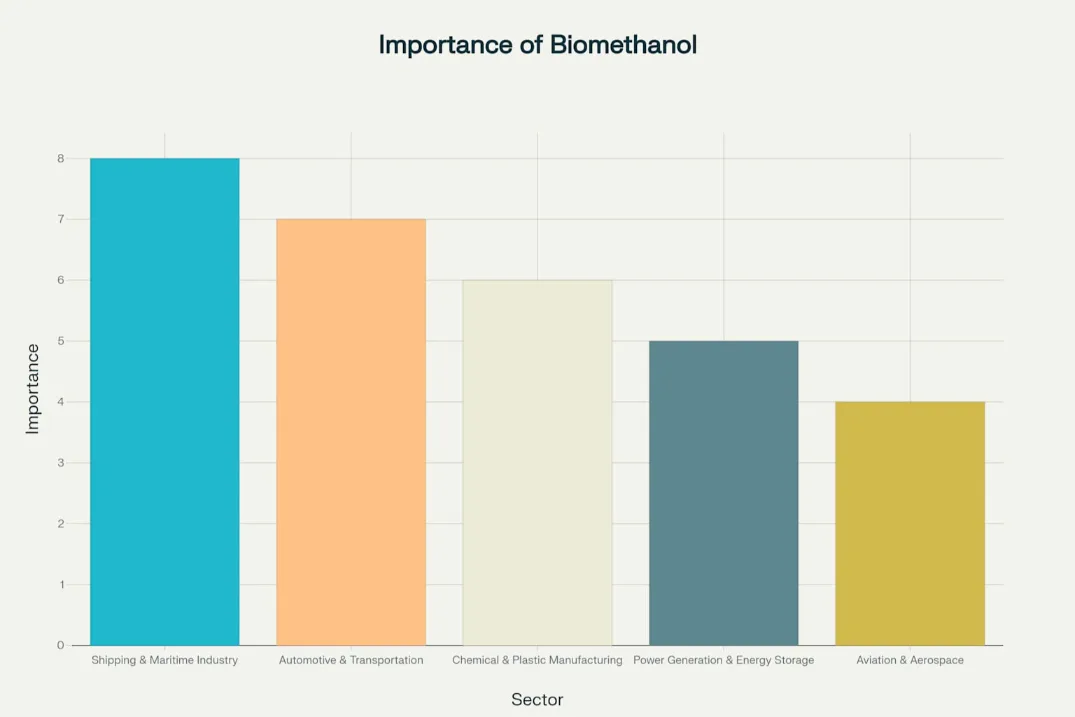
 Bar chart of Importance of Biomethanol in Different Sectors

The growing urgency to reduce greenhouse gas emissions and reliance on fossil fuels has propelled biomethanol into the spotlight. Its production and use offer significant environmental benefits, including substantial reductions in carbon emissions and the potential for a closed carbon cycle when produced from waste streams or captured CO₂.

Shipping & Maritime Industry

The maritime industry, responsible for a substantial share of global emissions, is undergoing a profound transformation as it seeks cleaner alternatives to heavy fuel oil. Biomethanol has emerged as a leading candidate for decarbonizing shipping operations due to its favorable environmental profile and operational compatibility.

Advantages
Reduced Emissions: Bio-methanol significantly lowers greenhouse gas emissions compared to conventional marine fuels, supporting International Maritime Organization (IMO) decarbonization targets.
Ease of Storage and Handling: Methanol is easier to store and handle than alternatives like hydrogen or ammonia, simplifying the transition for port infrastructure and ship operators.

Automotive & Transportation

Transportation accounts for nearly a quarter of global CO₂ emissions, making decarbonization of this sector a top priority. Biomethanol offers a practical and impactful solution, especially in applications where electrification is challenging or infrastructure is lacking.

Benefits
Lower Carbon Footprint: Biomethanol’s renewable origin means its lifecycle greenhouse gas emissions are significantly lower than those of fossil-derived fuels.
Economic Growth: The biomethanol fuel market is fostering new investment and job creation, particularly in regions rich in agricultural resources.

Chemical & Plastic Manufacturing

Methanol is a foundational building block in the chemical industry, serving as a precursor for a wide range of products including plastics, car parts, construction materials, textiles, and paints.

Power Generation & Energy Storage

Beyond its role as a fuel and chemical feedstock, biomethanol is gaining attention as a versatile energy carrier for power generation and storage.

Aviation & Aerospace

The aviation sector faces unique challenges in decarbonization due to the high energy density required for flight and limited alternatives to liquid fuels.

Future Outlook of Biomethanol

Biomethanol’s trajectory is closely tied to global efforts to decarbonize major industries and transition to a circular, low carbon economy.

Conclusion

Biomethanol stands at the forefront of the renewable energy revolution, offering a versatile, scalable, and low-carbon alternative to fossil derived methanol and fuels. Its applications span critical sectors from shipping and transportation to chemicals, power, and aviation delivering substantial environmental and economic benefits.

As innovation accelerates and markets mature, biomethanol is set to play a pivotal role in global decarbonization efforts, supporting the transition to a cleaner, more resilient, and sustainable energy future.

Investing in Biomethanol Stocks – Advanced Biofuels and Market Trends

5 Industries that could be Transformed by Biomethanol Read More »

Industrial facility with smokestacks and storage silos, illustrating the debate on biomethanol’s role in carbon-neutral transportation.

Is Biomethanol the key to Carbon-Neutral Transportation

Is Biomethanol the Key to Carbon-Neutral Transportation

As the global community accelerates its shift toward cleaner and more sustainable energy sources, the transportation sector remains one of the most difficult to decarbonize. Amid mounting concerns about climate change and growing carbon emissions, biomethanol has gained attention as a promising alternative fuel. But is biomethanol the key to carbon-neutral transportation? Let’s explore its environmental benefits, economic and technological viability, future applications, and the policy support needed for its widespread adoption.

Environmental Benefits of Biomethanol

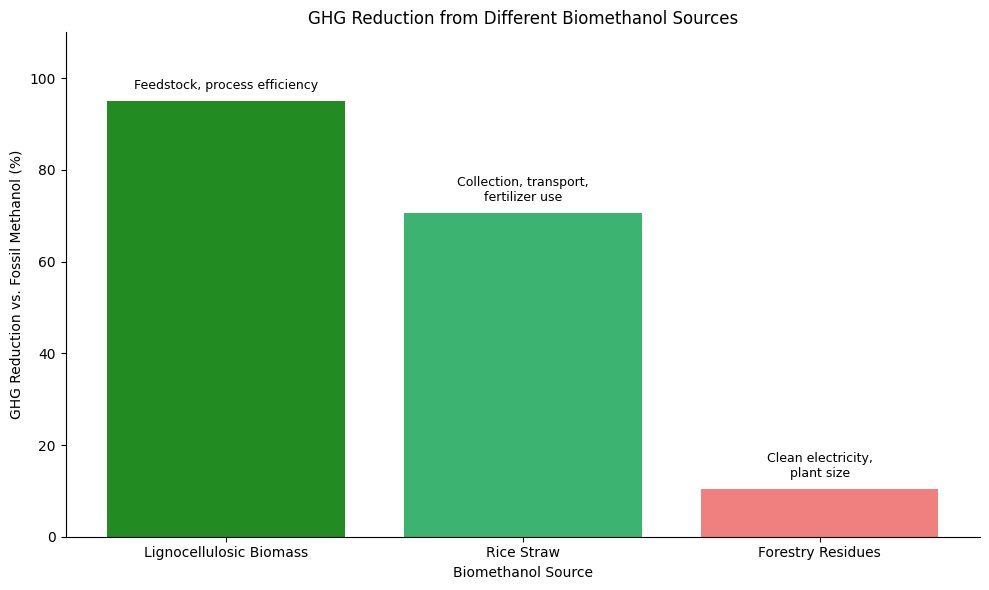
Biomethanol offers remarkable potential to reduce greenhouse gas (GHG) emissions compared to conventional fossil fuels. Studies suggest that it can cut carbon dioxide emissions by up to 95%, while nearly eliminating sulfur oxide emissions and substantially lowering nitrogen oxide levels. This results in cleaner air, reduced smog formation, and a healthier environment overall.

When produced from renewable biomass sources such as rice straw, forestry residues, or lignocellulosic feedstocks biomethanol delivers even stronger sustainability performance. Incorporating clean electricity and optimizing production processes can further reduce its life cycle emissions, positioning it as a leading candidate for carbon neutral fuel.

Additionally, biomethanol can be blended seamlessly with diesel or biodiesel, offering immediate emission reductions without significant modifications to existing engines, fuel storage systems, or refueling infrastructure.

Chart showing greenhouse gas emission reductions from different biomethanol resources compared to conventional fuels.

Economic and Technological Viability

While environmentally advantageous, biomethanol currently faces economic challenges due to higher production costs compared to fossil-derived fuels. These costs vary based on factors such as feedstock type, plant capacity, and the integration of renewable hydrogen into production systems.

However, technological innovation is rapidly improving cost efficiency. Advances in hydrothermal gasification, carbon capture integration, and renewable-powered synthesis are driving down emissions and operational expenses. Importantly, biomethanol is already a technologically mature and scalable option, and its long-term potential surpasses that of bioethanol in replacing gasoline despite requiring more energy during production.

Future Applications of Biomethanol

One of biomethanol’s greatest strengths lies in its versatility across transportation modes. It can be used directly in internal combustion engines, as a blend component in fuels, or as a marine fuel. The international shipping industry, in particular, has already begun adopting methanol as a cleaner alternative to heavy fuel oil.

Furthermore, biomethanol shows immense promise for hard to electrify sectors, including aviation, long-haul transport, and heavy-duty vehicles. Its compatibility with existing distribution infrastructure makes it an attractive pathway toward large-scale decarbonization. Future developments in e-fuels, synthesized from captured carbon dioxide and renewable energy, are also likely to position biomethanol at the forefront of sustainable fuel innovation.

Challenges and the Role of Policy Support

Despite its large potential, biomethanol’s widespread commercialization depends on overcoming several challenges:

  • Cost Reduction: Continued innovation and scale-up are essential to achieve price parity with conventional fuels.
  • Infrastructure Investment: Expanding refueling networks and adapting supply chains will ensure smoother integration into existing systems.
  • Policy Frameworks: Government incentives, renewable fuel mandates, and carbon pricing mechanisms will be critical drivers for market adoption.

Supportive policies that encourage investment, research, and commercial deployment can speed up biomethanol’s contribution to global decarbonization goals.

Conclusion:

So, is biomethanol the key to carbon neutral transportation? The answer leans strongly toward yes. With its impressive emission reductions, scalable technology, and adaptability across various transport modes, biomethanol stands out as a compelling candidate in the clean energy transition.

While challenges related to cost and infrastructure persist, ongoing innovation and government support can unlock its full potential. As countries push toward a zero-carbon future, biomethanol could play a transformative role in reshaping sustainable mobility for generations to come

Investing in Biomethanol Stocks – Advanced Biofuels and Market Trends

Is Biomethanol the key to Carbon-Neutral Transportation Read More »