india

Map of India highlighting Assam as a region for biomethanol production from rice straw to support rural clean energy and sustainability

Unlocking Rural India Clean Energy Future: Biomethanol from Rice Straw in Assam

Biomethanol from Rice Straw in Assam

India is at a crucial stage in its pursuit of sustainable growth, with clean energy solutions central to its development plans. Among the states, Assam shines due to its agricultural wealth and potential in renewable energy. This blog looks at how producing biomethanol from rice straw in Assam can transform rural energy systems, promote economic growth, and help India reach its clean energy goals.

Assam: The Green Heart of India Biomethanol Revolution

Agricultural Riches and Energy Challenges
Assam, located in Northeast India, is known for its rich fields and active agricultural sector. Almost half of its 78,438 square kilometers are cultivated, with rice as the main crop. Assam produces millions of tonnes of rice each year. However, this agricultural success leads to a significant by-product: rice straw. Often considered waste, rice straw is typically burned in open fields, causing severe air pollution and greenhouse gas emissions.

The Untapped Power of Rice Straw
Rice straw availability: In areas like Sonitpur, Assam, studies show an annual surplus of over 4,400 tonnes of rice straw from just 5,480 hectares of farmland. This surplus is enough to produce more than 1,200 tonnes of biomethanol per year, or about 3.3 tonnes per day, from a single group of villages.
Statewide potential: When considering the entire state, Assam’s total rice straw resource is enormous, making it an ideal candidate for local bioenergy production.

Why Is It a Game Changer for Assam?

Biomethanol is a renewable fuel made from organic materials, such as agricultural waste. Unlike fossil methanol, derived from natural gas or coal, biomethanol is produced through the gasification of biomass, followed by cleaning the syngas and synthesizing methanol.

Why Biomethanol?

  • Clean-burning: Biomethanol burns cleaner than fossil fuels, significantly lowering emissions of CO2, NOx, SOx, and particulate matter.
  • Versatile applications: It can be mixed with gasoline, used as a feedstock in the chemical industry, or act as a hydrogen carrier for fuel cells.
  • Circular economy: Turning agricultural waste into valuable fuel exemplifies a circular bioeconomy.

The Science: How Biomethanol Is Made from Rice Straw in Assam

The Gasification Pathway

  1. Collection and Pre-treatment: Rice straw is gathered from fields, dried, and pre-treated to lower ash content and enhance its suitability for gasification.
  2. Gasification: The straw undergoes partial oxidation at high temperatures to produce a syngas rich in hydrogen and carbon monoxide.
  3. Syngas Cleaning: Impurities like tar, particulates, and sulfur compounds are removed.
  4. Methanol Synthesis: The cleaned syngas is then transformed into biomethanol using catalysts.

Technical Innovations for Assam Rice Straw
High Ash Content Solutions: Assam’s rice straw has an ash content of 9 to 22%, which can cause operational problems. Advanced pre-treatment methods, like alkali treatment, and the use of cyclone gasifiers help prevent slagging and corrosion, ensuring smooth operations.
Energy Efficiency: Conversion efficiencies of 40 to 43% can be achieved, yielding about 0.275 to 0.308 kg of biomethanol per kg of rice straw.

Environmental Benefits: Biomethanol vs. Open Burning

The Pollution Problem
Burning rice straw is a significant environmental challenge in Assam and across India. Each tonne of straw burned releases:

  • 1,460 kg of CO2
  • 60 kg of CO
  • 5.7 kg of CH4
  • 0.07 kg of N2O
  • Significant amounts of particulate matter, NOx, and SOx

Biomethanol’s Green Advantages
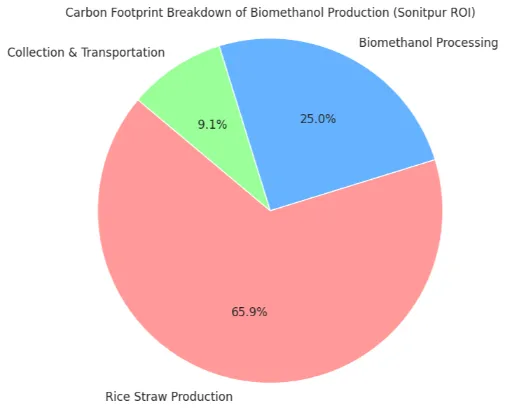
ROI( RETURN ON INVESTMENT) IN BIOMETHANOL PRODUCTION
  • Drastic Emissions Reduction: Biomethanol production from rice straw emits only 0.347 kg CO2e per kg of methanol, compared to 1,460 kg CO2 per tonne from burning.
  • Cleaner Combustion: It reduces NOx emissions by up to 80%, CO2 by 95%, and eliminates SOx emissions entirely.
  • Soil Health: It helps preserve beneficial soil microorganisms and maintains soil fertility, which is harmed by burning.

Economic Opportunity: Biomethanol as a Rural Game Changer in Assam

Feedstock Economics
Low cost resource: Delivered rice straw costs around INR 2.05/kg (USD 0.03/kg) for a 10 km transport, often less than the cost of burning or disposing of it.
Potential for negative cost: Farmers could be paid for providing straw, turning a disposal issue into a source of income.

Investment and Plant Economics
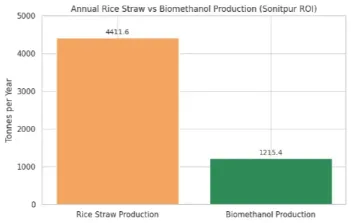
BAR CHART FOR RICE  STRAW PRODUCTION
  • Capital expenditure: A 50,000 tonne/year biomethanol plant requires a considerable investment, but costs decrease with size and government support.
  • Operational costs: These are heavily influenced by feedstock price and plant size, with economies of scale being essential for profitability.
  • Market prospects: The global biomethanol market is expanding quickly, with forecasts predicting high demand for sustainable fuels.

Government Support and Policy

  • Subsidies and incentives: The Indian government provides capital subsidies, for example, INR 15,000/kW for biomass gasification, and encourages second-generation biofuels through policy frameworks.
  • Carbon credits: The low carbon footprint of biomethanol can be monetized through carbon trading, increasing the project’s viability.

Socio Economic Impact: Empowering Rural Assam

Job Creation
Value chain employment: Biomethanol projects generate a variety of rural jobs, from straw collection and transport to plant operation and maintenance.
Skill development: New technical roles in bioenergy help develop skills and support rural industry.

Farmer Income Enhancement
New revenue streams: Commercializing rice straw gives farmers a stable, additional income, replacing the less profitable practice of burning or selling it at low value.
Case studies: Other regions have shown that farmers can earn up to INR 2,500 extra per season by selling straw for bioenergy.

Local Energy Security

  • Reduced fossil fuel dependence: Biomethanol production in Assam can help shield rural communities from unstable fossil fuel prices and supply disruptions.
  • Distributed generation: Decentralized plants near straw sources lower transport costs and ensure a reliable local energy supply.

Biomethanol and Assam: Aligning with India Clean Energy Vision

National Priorities

  • Methanol Economy Program: India’s initiative for a methanol economy aims to reduce crude oil imports, lower emissions, and improve rural incomes.
  • Biofuel blending targets: Government rules for ethanol and methanol blending in fuels boost demand for sustainable options like biomethanol.

Assam’s Strategic Advantage

  • Abundant feedstock: The consistent production of rice in Assam ensures a steady supply of straw, enabling year-round biomethanol production.
  • Policy alignment: Assam’s state policies and India’s national biofuel strategies are aligning to support bioenergy investments and rural development.

Overcoming Challenges: From Field to Fuel

Logistics and Supply Chain

  • Collection networks: Geographic Information System (GIS) technology helps map straw availability and create efficient supply chains, minimizing logistical costs.
  • Decentralized model: Smaller, distributed plants near sources of feedstock will optimize operations and cut transportation emissions.

Technical Barriers

  • Ash management: Innovations in pre-treatment and gasifier design tackle the high ash content of Assam’s rice straw, ensuring dependable plant operations.
  • Seasonal supply: Effective storage and planning are necessary to handle the seasonal availability of rice straw.

Financial Feasibility

  • Scale matters: Larger plants benefit from economies of scale, while using low-cost or negative-cost feedstock improves profit margins.
  • Multi-pronged strategy: Combining subsidies, carbon credits, and efficient logistics is crucial for making projects financially viable.

The Road Ahead: Strategic Recommendations for Assam

  • Promote decentralized biomethanol plants near rice straw clusters to maximize local benefits and reduce logistical challenges.
  • Invest in advanced pre-treatment and gasifier technologies to manage Assam’s unique feedstock characteristics.
  • Leverage government subsidies and carbon credits to improve financial returns and draw in investment.
  • Involve local communities and farmers to ensure a stable supply chain and fair economic benefits.
  • Integrate biomethanol into Assam’s clean energy plan, aligning with national biofuel goals and rural development objectives.

Conclusion: Biomethanol from Rice Straw in Assam

Assam is on the brink of a clean energy transformation. By harnessing biomethanol from rice straw, the state can turn an environmental problem into an economic advantage. This initiative will create rural jobs, boost farmer incomes, and contribute significantly to India’s net-zero goals. The journey from rice field to fuel tank unlocks Assam’s clean energy future while offering a model for sustainable rural development throughout India.

Biomethanol is not just a fuel; it is a catalyst for change, a driver of rural prosperity, and a key part of Assam’s path toward a greener, more resilient future.

Read our detailed insight on Biomethanol from Corn Straw in China: A Life Cycle Insight

Unlocking Rural India Clean Energy Future: Biomethanol from Rice Straw in Assam Read More »
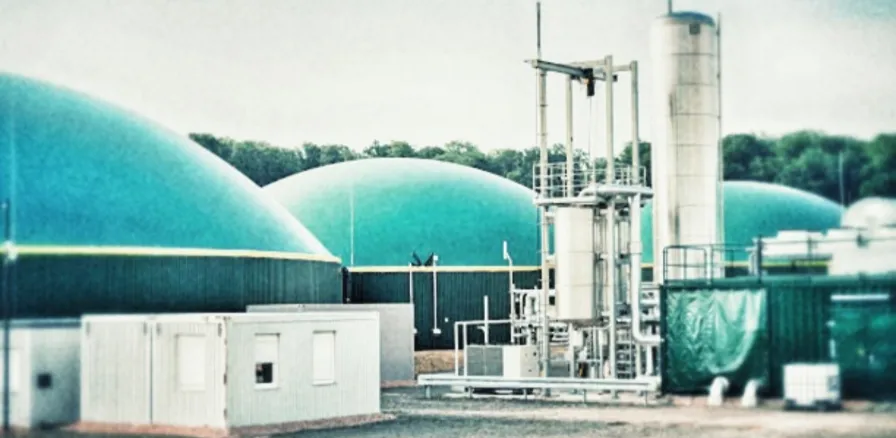
Biogas plant with large storage domes

Biogas to Methanol in India: Prospects and Barriers

Biogas to Methanol in India: A Pathway to a Sustainable and Self Reliant Future

India, with its ambitious goals for a “Methanol Economy” and a commitment to a net-zero future, is at a crossroads. The country’s growing energy demand, along with its large agricultural waste and organic residue, creates a unique chance to turn biogas into a clean, versatile fuel, methanol. However, this change comes with challenges. Although the future looks promising, we need to tackle important social, environmental, and financial obstacles to realize the full potential of this technology. This approach offers a way to transform abundant biogas resources into methanol, a versatile fuel and chemical feedstock, while reducing reliance on fossil fuels and lowering greenhouse gas emissions.

The Promising Prospect: Why Biogas to Methanol?

Methanol is a strategic energy product with multiple applications. It can be used as a clean-burning fuel for transportation (blended with petrol and diesel), a domestic cooking fuel, and a feedstock for various chemicals. Producing methanol from biogas, a product of anaerobic digestion of organic waste, offers a compelling solution to several of India’s pressing problems.  India generates large amounts of agricultural, municipal, and industrial waste, which can be converted to biogas. Using this biogas for methanol production supports waste valorization and a circular economy, turning waste into valuable products Gautam, P., , N., Upadhyay, S., & Dubey, S. (2020). 

First, it offers a way to achieve energy independence. India’s dependence on imported crude oil and natural gas creates a big economic burden. By producing methanol locally from plentiful biomass and organic waste, the country can greatly cut its import costs, which is a main goal of the NITI Aayog’s “Methanol Economy” program.

Second, it tackles the twin problems of waste management and air pollution. India produces millions of tons of agricultural waste and municipal solid waste each year. Much of this is poorly managed, resulting in landfill fires, methane emissions, and stubble burning. These issues lead to serious air pollution, especially in northern India.
Biogas-to-methanol can be economically viable, especially with policy support or carbon tax (Scomazzon, M., Barbera, E., & Bezzo, F. (2024).

Biogas-to-methanol plants can convert this waste into a valuable resource, creating a circular economy. The process also generates high-quality organic manure (digestate), which can replace chemical fertilizers, thereby improving soil health.

Third, it plays a major role in fighting climate change. Methane, the main part of biogas, is a powerful greenhouse gas that has a much greater effect than carbon dioxide over a short period. By capturing and turning biogas into methanol, we stop these emissions from getting into the atmosphere. The methanol we produce is a low-carbon fuel that can replace fossil fuels, which helps cut down greenhouse gas emissions even more.

The Roadblocks: Barriers to Implementation

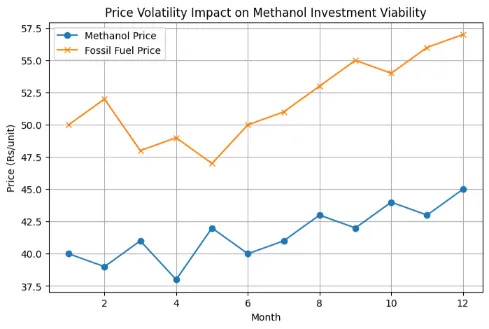
Methanol and fossil fuel price comparison

Despite these clear benefits, several hurdles stand in the way of widespread adoption of biogas-to-methanol technology in India. Policy, technology maturity, and supply chain issues remain challenges in India (Deng et al., 2024).

1. Financial and Economic Barriers

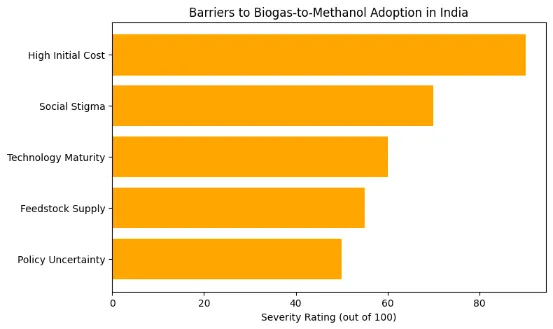
The high initial cost of setting up a biogas-to-methanol plant is probably the biggest challenge. A typical biogas plant already requires a significant investment for small operations. The extra equipment needed for gas upgrading and methanol production increases the costs even more. Lack of financing mechanisms and high upfront costs make it difficult for investors to fund large-scale biogas-to-methanol plants. This is a primary barrier identified by experts across sectors. Long payback periods and limited access to credit discourage private sector participation, especially for small and medium enterprises (Irfan et al., 2022). This makes it hard for project developers, especially smaller ones, to get financing.

Furthermore, the economic viability is heavily dependent on several factors that are often unpredictable. The cost and consistent supply of feedstock (agricultural waste, municipal solid waste, etc.) can be highly volatile. The price of methanol in the market, which is influenced by global fossil fuel prices, can also fluctuate, making it challenging to guarantee a stable return on investment.Targeted subsidies and feed-in tariffs for biogas and methanol production can make projects financially viable, especially for larger plants .

Investment support covering a high percentage of capital costs (up to 90–100%) is necessary for profitability in large-scale projects .

Innovative financing models and public-private partnerships can help mobilize capital and reduce risk  The current low import price of methanol in India also creates a disincentive for local production (Singh, Kalamdhad, & Singh, 2024).

Solutions and Prospects:

  • Policy Support and Subsidies: The government can help by providing capital subsidies and low-interest loans for project developers. This would lower the initial financial burden and draw in private investment.
  • Offtake Guarantees: Implementing a fixed-price offtake mechanism, similar to the SATAT (Sustainable Alternative Towards Affordable Transportation) initiative for compressed biogas (CBG), would provide financial security to project developers and de-risk investments.
  • Creating a Market for By-products: Establishing a robust market for the organic digestate (bio-fertilizer) would create a second revenue stream, improving the overall project economics.
  • Scalability and Decentralization: Comprehensive resource mapping and standardized procedures can reduce uncertainty and attract investment. Developing modular and scalable technologies can allow for smaller, decentralized plants that are more manageable and can cater to local waste streams, reducing transportation costs.Consistent policy frameworks and streamlined regulatory processes are needed to lower barriers and encourage private sector involvement.
Barriers to biogas adoption in India

2. Social and Cultural Barriers

The social and cultural context in India presents its own set of challenges. One of the primary barriers is the perception and acceptance of using certain types of waste, particularly animal and human waste, as feedstock for energy production. While anaerobic digestion is a well-established and hygienic process, social stigmas and a lack of awareness can hinder community acceptance and feedstock collection.

Additionally, the transition from traditional cooking fuels like firewood and LPG to methanol-based stoves requires behavioral change. In rural areas, where biogas could be a game-changer, the free availability of firewood often makes the financial investment in a biogas system seem unappealing to households, even with subsidies. The lack of awareness about the environmental and health benefits of clean cooking fuels is also a major impediment.

Solutions and Prospects:

  • Public Awareness Campaigns: Educating the public about the scientific process of anaerobic digestion, the hygienic nature of the technology, and the benefits of the resulting bio-fertilizer is critical. Highlighting the health benefits of using clean cooking fuel is also vital.
  • Community Engagement: Involving local communities in the planning and operation of biogas-to-methanol plants can foster a sense of ownership and build trust. This can be facilitated through community-level cooperatives.
  • Incentivizing Clean Cooking: Government programs that offer subsidized methanol cookstoves and a reliable supply of methanol canisters can encourage households to switch from traditional fuels.

3. Environmental and Technical Barriers

While the overall environmental impact of biogas-to-methanol is positive, there are specific challenges that need to be addressed. The process itself can be energy-intensive, and the source of the energy used is a key factor in determining the overall carbon footprint. For example, if the plant relies on fossil fuels for its own power needs, the environmental benefits are diminished. The management of the carbon dioxide (CO₂) separated from the biogas, a significant by-product, is also a critical issue. If vented, it reduces the overall environmental advantage.

Technologically, while the core processes of biogas reforming and methanol synthesis are well-established, their integration on a commercial scale, especially with a focus on efficiency and cost-effectiveness, is an ongoing area of research and development. Issues like the presence of impurities in biogas (such as hydrogen sulfide) can poison catalysts and reduce the efficiency and lifespan of the plant.

Solutions and Prospects:

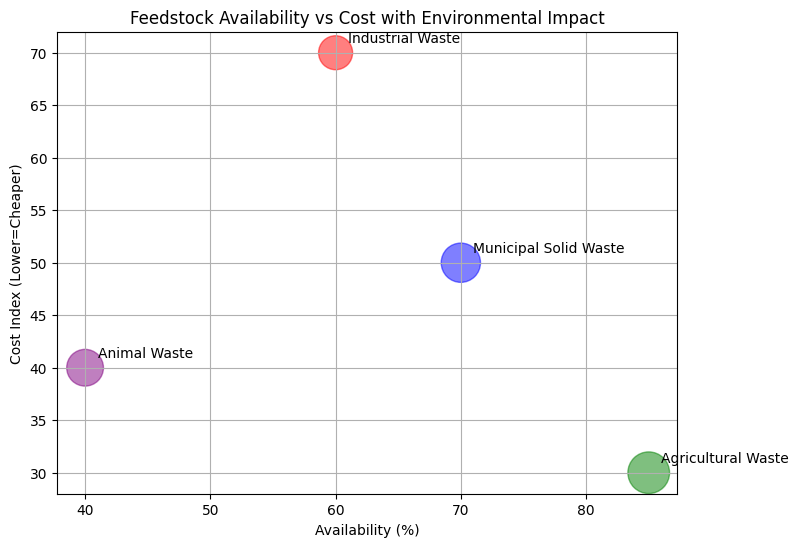
Graph comparing waste types and costs
  • Integration with Renewable Energy: Powering biogas-to-methanol plants with renewable energy sources like solar or wind power would maximize their environmental benefits, ensuring a truly green process.
  • Carbon Capture and Utilization (CCU): Integrating carbon capture technologies to utilize the separated CO₂ for methanol synthesis or other industrial applications (e.g., urea production) is a key solution. This not only enhances the methanol yield but also makes the process more carbon-neutral.
  • Indigenous Technology Development: Investing in research and development to create robust, efficient, and cost-effective indigenous technologies for biogas upgrading and methanol synthesis is crucial. The work being done by institutions like BHEL and IIT Delhi in this area shows promise.
  • Operational Training: Providing technical training to local personnel for the operation and maintenance of the plants will ensure their long-term viability and reduce reliance on external expertise.

Calculating the Benefits: Financial and Environmental Impact

The financial and environmental benefits of a successful biogas-to-methanol ecosystem in India are substantial and multifaceted.

Financial Benefits

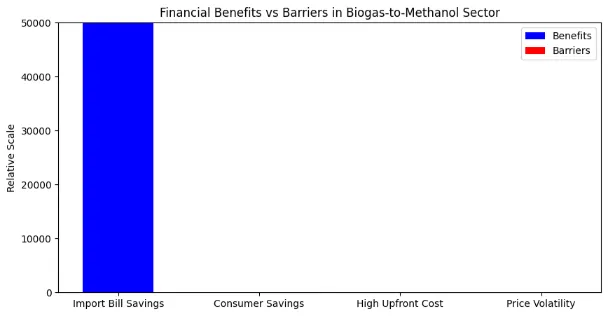
  • Reduced Import Bill: NITI Aayog estimates that the “Methanol Economy” can reduce India’s oil import bill by approximately Rs 50,000 crore annually. A significant portion of this saving can be attributed to indigenous methanol production from biomass .
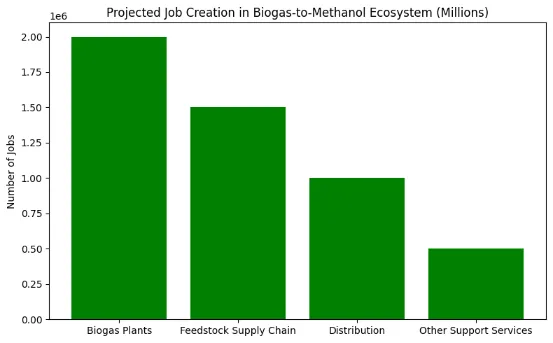
  • Job Creation: The establishment of biogas-to-methanol plants, along with the supporting supply chain for feedstock and distribution, can create millions of jobs, particularly in rural and semi-urban areas. NITI Aayog’s roadmap projects the creation of around 5 million jobs.
  • Rural Economic Development: The ability to sell agricultural residue as feedstock provides a new source of income for farmers, discouraging the practice of stubble burning and empowering rural economies.
  • Savings for Consumers: The use of methanol as a cooking fuel can result in significant savings for households, potentially lowering fuel costs by 20% compared to traditional LPG Ali, S., Yan, Q., Razzaq, A., Khan, I., & Irfan, M. (2022).
Bar chart of job creation projections

Environmental Benefits

Biogas-to-methanol development in India faces several environmental and technical barriers that limit its large-scale adoption. Addressing these challenges is essential for realizing the full potential of biogas as a sustainable methanol feedstock.

Bar graph comparing financial benefits and barriers
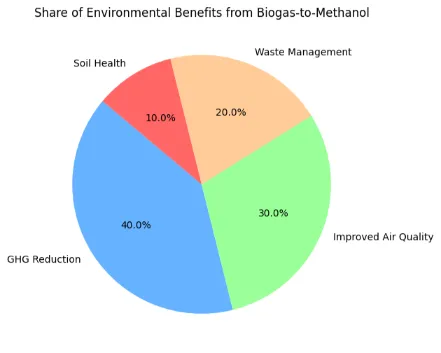
  • Greenhouse Gas Reduction: By preventing methane emissions from waste and replacing fossil fuels, biogas-to-methanol can be a major tool for climate change mitigation. The use of a 15% methanol blend (M15) in gasoline, for example, is estimated to reduce GHG emissions by up to 20%.
  • Improved Air Quality: The elimination of stubble burning and the use of clean-burning methanol fuel in vehicles and cookstoves will significantly reduce particulate matter, SOx, and NOx emissions, leading to a dramatic improvement in urban and rural air quality.
  • Waste Management: The widespread use of anaerobic digestion provides a sustainable and circular solution for managing organic waste, reducing the burden on landfills and improving sanitation.
  • Soil Health: The organic digestate produced as a by-product is a high-quality bio-fertilizer that can improve soil structure and fertility, reducing the need for chemical fertilizers, which have their own significant environmental footprint.
Pie chart of environmental benefits

Conclusion

The path from biogas to methanol in India looks promising. It offers a strong mix of economic, social, and environmental benefits. While there are challenges, such as high initial costs, social acceptance, and technology adoption, these challenges can be overcome. With focused policy support, public awareness efforts, and smart investment in local research and development, India can create a strong and decentralized biogas-to-methanol system. This will help the country reach its goals of energy independence and establishing a “Methanol Economy.” It will also foster a greener, cleaner, and more self-sufficient future for its people. The shift isn’t just about a new fuel; it involves creating a sustainable approach to waste management, energy security, and caring for the environment.

Citations

Bio-methanol as a renewable fuel from waste biomass: Current trends and future perspective. Fuel, 273, 117783. https://doi.org/10.1016/j.fuel.2020.117783.

Alternative sustainable routes to methanol production: Techno-economic and environmental assessment. Journal of Environmental Chemical Engineeringhttps://doi.org/10.1016/j.jece.2024.112674.

Biogas to chemicals: a review of the state-of-the-art conversion processes. Biomass Conversion and Biorefineryhttps://doi.org/10.1007/s13399-024-06343-1.

 Prioritizing and overcoming biomass energy barriers: Application of AHP and G-TOPSIS approaches. Technological Forecasting and Social Changehttps://doi.org/10.1016/j.techfore.2022.121524.

Unravelling barriers associated with dissemination of large-scale biogas plant with analytical hierarchical process and fuzzy analytical hierarchical process approach: Case study of India.. Bioresource technology, 131543 . https://doi.org/10.1016/j.biortech.2024.131543.

Modeling factors of biogas technology adoption: a roadmap towards environmental sustainability and green revolution. Environmental Science and Pollution Research International, 30, 11838 – 11860. https://doi.org/10.1007/s11356-022-22894-0.

Internal Link Card

Rice Straw to Methanol in India

Explore the potential of converting rice straw, a major agricultural waste, into methanol. This article examines the feasibility, emissions, and how this can boost India’s biofuel industry.

Read the Full Article

Biogas to Methanol in India: Prospects and Barriers Read More »

india blending ethanol

India Accelerates Ethanol Blending to Boost Energy Independence

India Accelerates Ethanol Blending

India has made significant strides in ethanol blending over the years, reflecting its commitment to enhancing energy security and reducing carbon emissions. Since the inception of ethanol blending initiatives in 2001, the country has progressively increased its ethanol penetration, reaching a national average of 12% v/v in the 2022-2023 ethanol supply year. This growth is supported by the government’s policies, which include reducing the goods and services tax on fuel ethanol and providing financial assistance for expanding grain-based ethanol production facilities.

In response to growing ethanol demand, India has ramped up its production capacity. By 2023, the country achieved an ethanol production capacity of over 10.82 billion litres annually, significantly surpassing previous years. Despite these advancements, India’s ethanol production still trails its consumption, necessitating further investments to achieve future targets, such as the ambitious E20 mandate slated for 2025.

Comparatively, India’s ethanol blending policies are more stringent than Brazil’s, particularly regarding quality specifications like minimum octane numbers and maximum sulfur content. While Brazil leads with a higher blending mandate of up to 27.5% v/v, India’s focus on ultra-low sulfur fuels showcases its commitment to cleaner energy solutions. However, as a net importer of ethanol, India faces challenges in matching Brazil’s production and consumption levels.

Projections in Ethanol Blending

To address these challenges, India is encouraging the adoption of flex-fuel technology in the automotive sector. Automakers are beginning to introduce flex-fuel vehicles, with Toyota launching a pilot for a flex-fuel hybrid in 2022. This move aligns with India’s goal of increasing ethanol usage across the transportation sector, setting the stage for a more sustainable and self-reliant energy future.

Get more info

To get more info check out inspire.sgs.com
Also trending topic Heat wave warnings

India Accelerates Ethanol Blending to Boost Energy Independence Read More »