
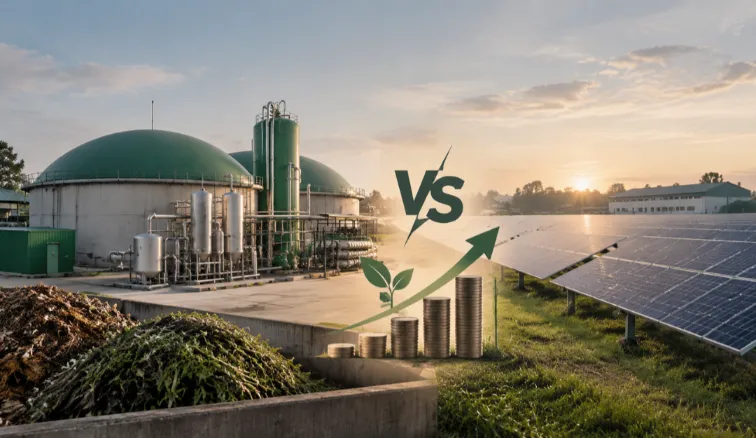

Businesses are comparing compressed biogas and solar energy because of the many reasons: Compressed biogas and solar energy are being compared by businesses because of the reasons:
For the farming and manufacturing sector, renewable energy has emerged as a viable investment option to lower operational expenses, enhance energy security, and contribute to sustainability objectives. The two technologies that are attracting a lot of attention are compressed biogas (CBG) and solar energy. Whereas in solar, sun energy is used to generate electricity, in compressed biogas organic waste is converted into a useful fuel source. Both technologies have financial and environmental advantages, but their financial returns vary based on specific factors such as location, energy requirements, resources available, and business goals.
What is compressed biogas and what value can it create?
Biogas can be made from organic material at high pressure, like agricultural residues, animal manure, food waste and industrial waste—it is a renewable fuel. The organic materials are fed into a digester where they are broken down anaerobically to produce biogas which is cleaned and compressed into a usable clean energy source.
Research on farm-scale anaerobic digestion shows that manure-based biogas plants can pay for themselves quickly. A study of a 400-head dairy farm found that a combined heat and power plant reached a payback of about four years with an internal rate of return of roughly 26%. Bio-fertilizer income alone exceeded the income from electricity in one scenario, showing that digestate is a real revenue stream (Rouhollahi et al., 2020, Journal of Cleaner Production).
CBG can turn a problem into a profitable solution for farms. Biogas systems can help factories to reduce their reliance on traditional fuels and enhance their waste treatment processes.
How can fares and factories save money using solar energy?
PVs convert the sun’s energy into electricity. Solar energy can be utilized at farms for irrigation, livestock operations, cooling and storage facilities. Electricity bills can be lowered and factories can protect themselves from rising electricity rates by installing rooftop or ground mounted solar.
The primary monetary benefit of solar is the reduced operating expense once it is installed. When once installed, solar panels produce electricity for many years with very low maintenance costs.
Comparing the ROI of Compressed Biogas vs Solar Renewable Energy?
The cost of compressed biogas (CNG) and solar energy depends on various factors. Installation, maintenance and deployment of the solar option is typically simpler, with lower maintenance needs and quicker deployment. Compressed bio gas, however, can offer extra advantages in the areas of waste disposal and creation of a valuable fuel product.
Recent research suggests solar has the edge on pure cost: over the last decade, solar costs have fallen sharply while bioenergy costs have barely moved. A comparison of co-located systems in India found solar PV electricity cheaper than biogas-based electricity. Biogas, however, earns its place where organic waste is abundant, because it also delivers fuel, fertilizer and waste treatment. For many farms, a hybrid of solar for daytime power and biogas for continuous heat or fuel offers the strongest return.
CBG can generate multiple sources of revenue for farms with good amount of organic waste materials. Solar can offer greater financial benefits for large roof spaces that have unused space or high electricity usage.
The need for Compressed Biogas Plant in Farms?
Agricultural and animal wastes are among the major wastes produced by farms which can be environmental problems if not managed properly. CBG plants enable farmers to produce nutrient-rich and valuable digestate as fertilizer, and renewable fuel as well.
This is the circular approach, which enhances the overall efficiency of the resources and generates new value-added opportunities. Biogas investments are now increasingly being explored by large dairy farms, livestock farms and agricultural enterprises.
One of the main problems that industrial electricity has is the cost of electricity. With solar energy, manufacturers can lower their reliance on grid electricity while dealing with long-term operational costs. Large roof, warehouses and open areas in industries can be utilized for installing solar plants to produce clean energy at the production point.
Additionally, Solar helps achieve corporate sustainability goals by helping to lower the carbon footprint of conventional energy sources.
So, what are the important considerations for determining the ROI of renewable energy?
The choice of between compressed biogas and solar is dependent on several factors. Profitibility is affected by initial capital investment, available resources, energy consumption patterns, government incentives, maintenance needs, and energy system life.
CBG can provide great returns for a farm situated close to the biomass resources, but a factory in a sunny area could be better served by solar power generation.
Which is Cheaper to Maintain, Compressed Biogas or Solar?
Solar systems are typically less-maintenance due to the reduced number of moving parts. Good performance usually can be maintained with routine cleaning and periodic inspections. CBG plants need to be run more than the traditional ones due to their biological nature, feedstock handling, gas purification and equipment monitoring.
The cost of maintaining the CBG, however, can be justified in terms of fuel production and waste management savings, as well as other agricultural benefits.
Not all farms and factories have to select just one renewable technology. Hybrid renewable energy model can be a combination between production of compressed biogas fuel and electricity production from solar energy. Solar can be used for electricity generation during the day, and biogas can be used for heating, transport fuels or energy generation on an ongoing basis.