

Biomass Briquettes vs Coal vs Furnace Oil: Which Fuel Is Cheaper for Your Industry in Pakistan
For decades, Pakistani industries relied on furnace oil and natural gas. When gas shortages hit, many shifted to imported coal. But with furnace oil prices climbing, coal imports costing foreign exchange and facing supply delays, and the government tightening environmental regulations due to smog, a third option has moved into the spotlight: biomass briquettes in Pakistan.
Fuel is one of the largest recurring expenses for any industrial unit in Pakistan. Whether you run a textile mill in Faisalabad, a brick kiln on the outskirts of Lahore, a steam boiler in Karachi’s industrial zones, or a food processing plant in Sialkot, the fuel you choose directly decides your profit margin.
This guide compares all three fuels biomass briquettes, coal, and furnace oil on the metrics that actually matter to a factory owner: price, calorific value, running cost per unit of heat, boiler compatibility, and environmental impact. By the end, you’ll be able to calculate which fuel genuinely costs you less, not just at purchase but over a full year of operation.
(Note: Fuel prices in Pakistan fluctuate with the exchange rate, seasonal demand, and government policy. The figures below are indicative ranges to help you understand the comparison method always confirm current rates with suppliers before finalizing your budget.)
Why Pakistani Industries Are Reconsidering Their Fuel Choice
Three pressures are forcing industrial buyers across Pakistan to rethink fuel:
Rising and volatile fossil fuel prices. Furnace oil is priced in dollars, which means every depreciation of the rupee translates into an immediate cost increase at the factory gate. Coal imports face the same problem, plus freight costs, port charges, and customs duties. Local coal varieties such as Lakhra are cheaper but come with low calorific value and high ash content, which reduces real-world efficiency.
Environmental regulations and smog control. Provincial environmental protection agencies, particularly in Punjab, have intensified restrictions on high-emission fuels. Industries using furnace oil and low-quality coal face pressure through smog policies, emission standards, and in some sectors, mandatory conversion programs. Brick kilns have already been forced to adopt cleaner technology, and similar scrutiny is spreading to boilers in textile, food, and chemical processing.
Availability of a local alternative. Pakistan generates hundreds of millions of tons of agricultural waste every year — rice husk, wheat straw, cotton stalks, bagasse, corn cobs, and sawdust from furniture and timber units. Most of this was traditionally burned in fields, contributing to winter smog. Biomass briquetting converts this waste into a dense, dry, high-energy fuel that industries can actually use. The raw material is domestic, so there is no import bill and no dollar exposure.
This combination expensive fossil fuels, tightening regulations, and abundant local raw material is exactly why searches for biomass briquettes in Pakistan have grown so quickly among factory owners and boiler operators.
What Are Biomass Briquettes in Pakistan?
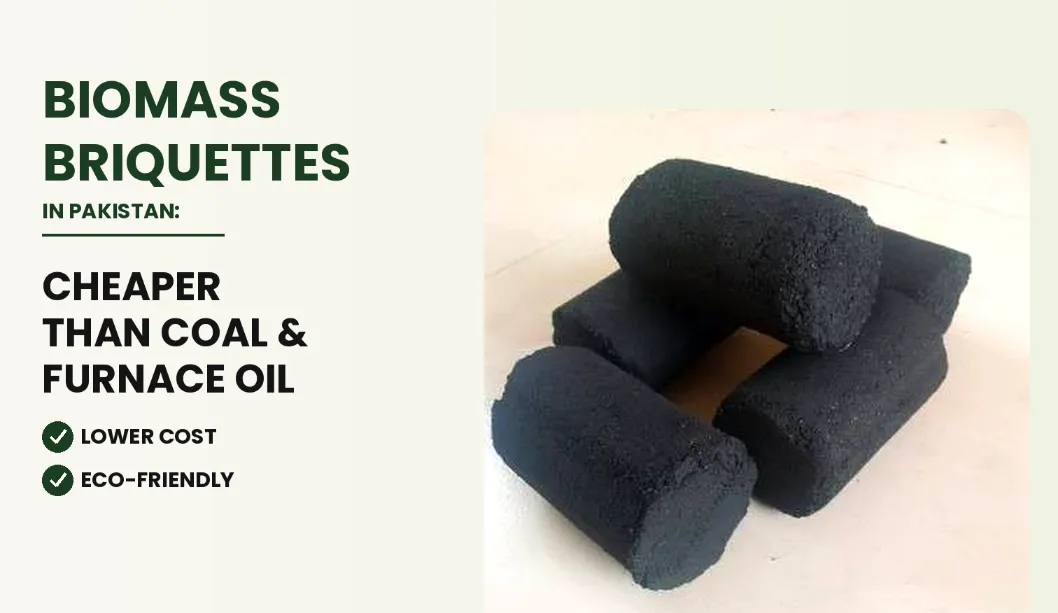
Biomass briquettes are compressed blocks made from agricultural and forestry waste. Raw materials such as rice husk, sawdust, bagasse, corn cobs, or cotton stalks are dried, crushed, and compressed under high pressure often without any chemical binder into solid cylindrical or pillow-shaped blocks.
The compression process removes moisture and packs the biomass tightly, which gives briquettes several properties that loose agricultural waste does not have:
- High density: Briquettes pack far more energy per kilogram than loose husk or straw, making them economical to transport and store.
- Low moisture content: Good-quality briquettes carry roughly 8–12% moisture, compared to 25–40% in raw crop residue. Less moisture means more of the fuel’s energy goes into producing heat instead of evaporating water.
- Consistent calorific value: Typical briquettes deliver a gross calorific value (GCV) in the range of 3,800–4,800 kcal/kg, depending on the raw material used.
- Clean burning: Briquettes produce minimal smoke and far less ash than coal, and contain virtually no sulfur.
Briquettes vs pellets a quick clarification. Buyers often ask about the difference. Pellets are smaller (typically 6–8 mm in diameter), machine-fed, and suited to automated pellet burners. Briquettes are larger blocks suited to manual or semi-automatic feeding in boilers, furnaces, and kilns. Both are biomass fuels; the right choice depends on your existing equipment and feeding system.
For most Pakistani industries with existing coal or oil-fired boilers, briquettes are the more practical conversion route, which is why they dominate the industrial biomass market in the country.
The Head-to-Head Cost Comparison
Now for the question every buyer actually asks: which fuel is cheapest?
Comparing fuels by price per ton (or per liter) is misleading, because each fuel delivers a different amount of heat per unit. The honest comparison is cost per unit of useful heat delivered to your process, which accounts for both the fuel’s calorific value and your boiler’s combustion efficiency.
| Fuel | Typical Price (Indicative) | Calorific Value | Typical Boiler Efficiency | Ash / Residue |
|---|---|---|---|---|
| Biomass briquettes | PKR 20,000–30,000 / ton | 3,800–4,800 kcal/kg | 75–85% | Low (3–8%) |
| Local coal (Lakhra/Sharigh) | PKR 18,000–28,000 / ton | 4,000–5,500 kcal/kg | 65–75% | High (15–30%) |
| Imported coal | PKR 40,000–55,000 / ton | 5,800–6,800 kcal/kg | 75–82% | Moderate (10–15%) |
| Furnace oil | PKR 160–220 / liter | ~10,000 kcal/kg | 80–88% | Negligible |
Indicative Fuel Prices and Energy Content in Pakistan
Worked Example: Cost per Million kcal of Useful Heat
Let’s take mid-range figures and calculate the cost of delivering one million kcal of usable heat:
- Biomass briquettes at PKR 25,000/ton, 4,500 kcal/kg, 80% efficiency: → roughly PKR 6,900 per million kcal
- Local coal at PKR 22,000/ton, 4,800 kcal/kg, 70% efficiency: → roughly PKR 6,500 per million kcal
- Imported coal at PKR 48,000/ton, 6,300 kcal/kg, 78% efficiency: → roughly PKR 9,800 per million kcal
- Furnace oil at PKR 190/liter, ~9,900 kcal/liter, 85% efficiency: → roughly PKR 22,600 per million kcal
What This Table Tells You
- Furnace oil is by far the most expensive option — often 2 to 3 times the running cost of biomass for the same heat output. Any facility still running on furnace oil has the largest savings opportunity.
- Imported coal looks cheap per ton but not per unit of heat, especially once freight, duties, and rupee depreciation are factored in. Its real cost is unpredictable because it is dollar-linked.
- Local coal is briquettes’ closest competitor on raw running cost, but the comparison changes when you account for the full picture: local coal’s high ash means more cleaning, more disposal, more wear on equipment, and higher maintenance. Add in emission compliance costs, and briquettes frequently come out ahead — or at worst at parity, without the regulatory risk.
For a mid-sized steam user consuming 300–500 tons of coal per year, switching to biomass briquettes commonly delivers 20–40% total energy cost savings versus furnace oil, and often a meaningful saving versus imported coal as well — with the added benefit of predictable, locally-sourced pricing.
Environmental and Compliance Benefits
Cost alone doesn’t tell the whole story. The environmental case for biomass briquettes has become a business case:
- Carbon neutrality: The CO₂ released by burning biomass is part of the natural carbon cycle — the crops absorbed that carbon while growing. Burning fossil fuels, by contrast, releases carbon that was locked underground for millions of years. Switching from coal or furnace oil to biomass can cut your facility’s net CO₂ emissions dramatically.
- Minimal sulfur: Furnace oil and coal contain sulfur, which produces sulfur dioxide — a key contributor to acid rain and respiratory illness. Biomass briquettes contain almost no sulfur, so SO₂ emissions are near zero.
- Reduced particulate pollution: High-quality briquettes burn cleaner than coal, producing less soot and fly ash. With smog emergencies now a recurring feature of winters in Lahore and other cities, industries in Punjab face real regulatory and reputational pressure to cut emissions.
- Solving a waste problem: Every ton of briquettes burned is a ton of agricultural residue that wasn’t burned in an open field — one of the major causes of seasonal smog. Industries using biomass can genuinely market themselves as part of the solution.
- Future-proofing: As Pakistan pursues its renewable energy targets under policies from the Alternative Energy Development Board (AEDB) and international climate commitments, having a renewable fuel profile protects you from future carbon taxes, emission penalties, or buyer requirements. Export-oriented industries, in particular, increasingly face questions about their carbon footprint from international buyers.
Which Fuel Fits Your Industry?
The “cheapest” fuel is also the one that works with your equipment and process. Here’s how the three fuels map to common Pakistani industries:
Textile and garment processing (steam boilers): Briquettes perform excellently in packaged steam boilers and thermic fluid heaters. Many mills in Faisalabad and Lahore have already converted. Ideal choice: biomass briquettes.
Food processing and pharmaceuticals: Clean combustion matters where product purity is a concern. Briquettes produce far less smoke and odor than coal. Ideal choice: biomass briquettes.
Brick kilns: The sector has been pushed toward cleaner technologies. Briquettes and other biomass fuels are viable in converted kilns, while local coal remains in use where permitted. Ideal choice: briquettes or local coal, depending on your conversion status.
Chemical and heavy process industries with very high, continuous heat demand: Large plants sometimes use imported coal or a mix. However, hybrid setups — biomass for base load, fossil fuel for peak — can capture savings without operational risk.
Facilities with automated burner systems and no manual labor for feeding: If your system requires automated fuel feeding, discuss pellet burners or briquette-compatible feeding systems with your supplier before converting.
The practical takeaway: if you currently run furnace oil, you have the most to gain from switching immediately. If you run imported coal, switching saves money and removes exchange-rate risk. If you run local coal, the switch is roughly cost-neutral on fuel but saves on maintenance, ash handling, and compliance.
How to Switch to Biomass Fuel: A Step-by-Step Approach
Converting your facility is usually simpler than buyers expect. Follow this sequence:
- Audit your current consumption. Record your fuel use (tons of coal or liters of oil per month) and your steam or heat output. This is your baseline for savings calculations.
- Check boiler compatibility. Most coal-fired boilers can fire briquettes with minor modifications adjustments to the grate, air supply, and feeding arrangement. A supplier experienced in conversions can assess your unit. Oil-fired boilers may require a burner change or a more significant conversion.
- Get a trial batch. Reputable briquette suppliers will provide a trial quantity so your operators can test burn rate, ash behavior, and steam output before you commit.
- Calculate your ROI. Using the cost-per-million-kcal method above, plug in current quoted prices. Most conversions pay back the modification cost within months, not years.
- Plan storage. Briquettes must stay dry. Allocate a covered, ventilated storage area — a single month’s supply typically requires less space than the equivalent energy in loose husk or wood.
- Train operators. Briquette firing is slightly different from coal firing. A short training session on feeding rate and air control usually makes your team fully proficient.
- Secure a reliable supply contract. Consistency of quality (moisture content, calorific value, size) matters more than a one-time low price. Choose a supplier who guarantees specifications and can deliver year-round, including in seasonal demand peaks.
Frequently Asked Questions
What is the price of biomass briquettes in Pakistan?
Briquette prices typically range from PKR 20,000 to 30,000 per ton, depending on the raw material, calorific value, moisture content, and order volume. Because briquettes are made entirely from local agricultural waste, their price is far more stable than dollar-linked furnace oil or imported coal. Always request a specification sheet with the current GCV along with the quotation.
Can I use biomass briquettes in my existing coal boiler?
In most cases, yes. Coal-fired boilers and furnaces can generally fire briquettes with minor adjustments to the feeding system, grate, and air settings. Efficiency may actually improve because briquettes have lower moisture and ash than local coal. A site assessment by your supplier will confirm any modifications needed.
What is the calorific value of biomass briquettes?
Good-quality briquettes deliver between 3,800 and 4,800 kcal/kg. The exact figure depends on the raw material — briquettes made from hardwood sawdust tend to sit at the higher end, while those from crop residues sit slightly lower. Compare fuels on price per kcal, not price per ton.
What raw materials are used to make briquettes in Pakistan?
Common feedstocks include rice husk, sawdust, bagasse (sugarcane waste), corn cobs, wheat straw, cotton stalks, and fallen leaves. This is why briquette production is strong in agricultural regions of Punjab and Sindh — the raw material is abundant and inexpensive.
Is biomass fuel environmentally approved for industries in Pakistan?
Yes. Biomass is classified as a renewable fuel and is part of Pakistan’s alternative and renewable energy policy framework. It burns far cleaner than furnace oil and coal, and using it helps industries meet provincial emission and smog-control requirements. That said, you should still ensure your boiler installation complies with local environmental protection agency standards.
How should I store biomass briquettes?
Store them in a covered, dry, ventilated area, raised off the ground if possible. Because briquettes absorb moisture, exposure to rain or humidity reduces their calorific value. With proper storage, briquettes keep well for a year or more.
Conclusion: The Numbers Favor Biomass
When you compare the three major industrial fuels in Pakistan honestly — on cost per unit of useful heat rather than price per ton — the ranking is clear:
- Furnace oil is the most expensive option by a wide margin and carries full exposure to exchange-rate volatility.
- Imported coal is mid-range in cost but unpredictable in price and increasingly constrained by environmental policy.
- Biomass briquettes in Pakistan deliver the lowest or near-lowest running cost, the best environmental profile, and the most stable pricing — because the fuel source is Pakistan’s own agricultural waste.
For most Pakistani industries with steam boilers, thermic fluid heaters, or kilns, biomass briquettes are not just the “green” option anymore. They are the financially smart option.
Ready to calculate your actual savings? Contact our team at BiofuelsPK for a free fuel assessment and a trial shipment of biomass briquettes in Pakistan sized to your boiler’s requirements. We’ll help you compare your current fuel cost against a biomass conversion — with real numbers, not estimates