ethanol

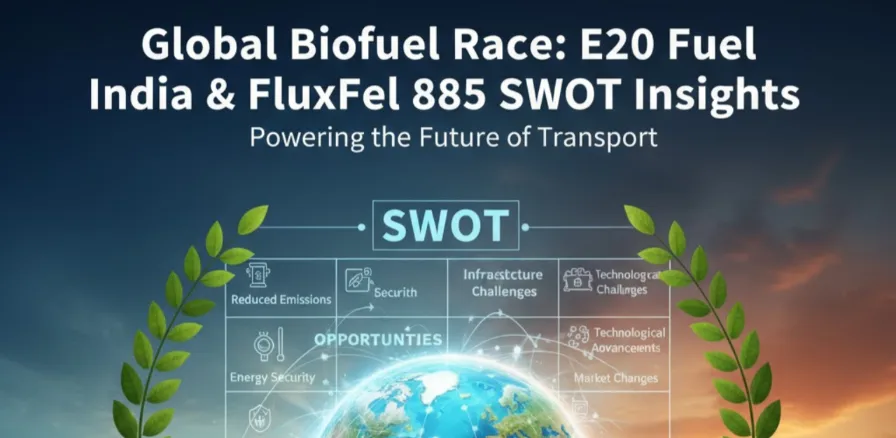
Digital illustration comparing E20 Fuel (India) and FluxFuel E85 biofuel initiatives, featuring two fuel pumps (one labeled 'E20 Fuel' with Indian elements, one labeled 'FluxFuel E85') flanking a glowing globe surrounded by a SWOT analysis diagram (Opportunities, Strengths, Weaknesses, Threats). The background shows a futuristic city skyline and lush greenery.

Global Biofuel Race: E20 Fuel India & FluxFuel E85 SWOT Insights

The Great Green Rush: A SWOT Analysis of the Global Biofuel Race, Featuring E20 Fuel India and FluxFuel E85

The race to decarbonization worldwide is not a sprint; it’s a high stakes, technology driven marathon. At the heart of this competition are advanced biofuels, primarily ethanol and biodiesel, designed to displace fossil fuels. Two prominent players defining the current landscape are E20 fuel India (a 20% ethanol blend rapidly adopted by one of the world’s largest consumer markets) and the international potential of FluxFuel E85 (the 85% ethanol blend that powers Flexible Fuel Vehicles, or FFVs). India targets 20% ethanol blending (E20) by 2025, aiming to cut oil imports and emissions. Production capacity is expanding, but feedstock (sugarcane, grains) may fall short, risking unmet targets and food security concerns (T & K, 2023).

A comprehensive SWOT analysis of these technologies reveals the critical strengths, inherent weaknesses, immense opportunities, and significant threats that will determine their long-term viability in the Global Biofuel Race.

A Sneak Peek on India: The E20 Acceleration

India’s shift to E20 fuel India a blend of 20% ethanol and 80% gasoline is one of the most aggressive biofuel rollouts globally. Initially targeting 2030, the country has significantly fast tracked the E20 implementation, driven by national energy security goals and a massive push to cut its crippling crude oil import bill.

Strengths : Energy choices and GHG Reduction

  • Energy Security and Forex Savings: The primary driver is reducing reliance on imported crude oil. The Ethanol Blending Programme (EBP) has already resulted in billions of dollars in foreign exchange savings, with the revenue now circulating within the domestic agricultural economy.
  • Rural Economic Boost: Ethanol is sourced primarily from agricultural feedstocks (sugarcane, damaged grains, and maize). This provides farmers with a stable secondary income, helping to clear crop debt and improving the economic viability of farmers.
  • Decarbonization Impact: Ethanol is a cleaner burning fuel. Studies revealed that the use of E20 fuel can lead to a significant reduction in lifecycle Greenhouse Gas (GHG) emissions up to 50–65% lower than gasoline, depending on the feedstock. The higher octane number of E20 (up to RON 95) also promotes better anti-knocking properties and performance globally in compatible engines.

Weaknesses : Technical Barriers and Resource origins

  • Vehicle Compatibility and Corrosion: A major weakness is the compatibility of the existing vehicle fleet. While all new cars are E20-compliant, millions of older vehicles lack the specialized material to handle the corrosive nature of the higher ethanol concentration, potentially leading to fuel system damage and leaks.
  • Fuel Efficiency Loss: Ethanol has a lower energy density than pure gasoline, resulting in a reported drop in fuel efficiency (mileage) for non-optimized vehicles, a key concern for consumers.
  • Water and Food Security Concerns: The dependence on water intensive crops like sugarcane raises environmental stress concerns. Furthermore, the diversion of food crops (like rice and maize) to fuel production ignites the contentious “food vs. fuel” debate, risking food inflation and impacting cattle feed supply.

Global Flex-Fuel Standard: The FluxFuel E85 Potential

FluxFuel E85 refers to the high-level blend of 85% ethanol and 15% gasoline, the established standard for Flexible Fuel Vehicles (FFVs) primarily in the US and Brazil. Its potential lies in offering the maximum carbon reduction benefit from ethanol, but its uptake is tightly bound to FFV penetration and infrastructure.

Opportunities (O): Market Expansion and Next-Gen Fuels

  • Global FFV Market Growth: The market for Flex Fuel Engines is projected to grow significantly, driven by stringent global emission regulations and the demand for sustainable automotive technologies. This creates a ready-made market for FluxFuel E85.
  • Second-Generation (2G) Biofuels: The push for E85 accelerates the development and commercialization of 2G ethanol derived from non-food sources (agricultural residues, waste biomass, etc.). This advancement directly addresses the food-vs-fuel conflict inherent in first-generation biofuels. India, for example, is investing in 2G refineries to convert agricultural waste (like parali) into ethanol.
  • Technological Convergence: FFVs(Flex Fuel Vehicles) are increasingly being integrated with hybrid and plug-in hybrid electric vehicle (PHEV) systems, offering a “flex-hybrid” solution that maximizes efficiency while running on low-carbon fuel blends like FluxFuel E85.

Threats (T): Framework and Competition

  • Infrastructure Investment and Availability: The primary constraint for widespread FluxFuel E85 adoption is the lack of ubiquitous E85-compatible fueling stations. Retrofitting existing stations to handle high-ethanol blends is expensive, and distribution infrastructure remains geographically limited.
  • Competition from Electrification (EVs): The most significant long-term threat is the rapid ascent of Battery Electric Vehicles (BEVs). As charging infrastructure matures and battery costs decline, BEVs could eventually leapfrog high-blend ethanol fuels, particularly in the light-duty vehicle segment.
  • Price Parity and Volatility: For FluxFuel E85 to be economically attractive to consumers, its pump price must be sufficiently lower than gasoline to offset the typical 20–30% drop in fuel efficiency (due to ethanol’s lower energy content). Achieving and maintaining this price parity is a constant market challenge, often requiring sustained government subsidies.

Navigating the Biofuel Crossroads

The success of the biofuel race hinges on converting the listed weaknesses and threats into manageable challenges and capitalizing on the opportunities.

For E20 fuel India, the immediate focus must be on mitigating consumer anxiety regarding older vehicles. This involves:

  1. Incentivizing E20 Upgrade Kits: Providing tax breaks or subsidies for owners of non-compliant vehicles to install certified E20-compatible conversion kits.
  2. Maintaining a Low-Blend Option: Temporarily continuing to offer lower-blend gasoline (E0 or E10) at select pumps for non-compliant vehicles, as a customer retention and safety measure.
  3. Sustainable Feedstock Strategy: Aggressively scaling up 2G ethanol production to eliminate the pressure on food crops and water resources.

For the wider adoption of FluxFuel E85, the need is global standardization and infrastructure build-out:

  1. Mandates for FFV Manufacturing: Governments must follow the example of Brazil and actively mandate and incentivize the sale of FFVs to increase the addressable market for E85.
  2. Public-Private Investment: Strategic government investment and tax incentives are crucial to rapidly expand the FluxFuel E85 retail network beyond current concentrations.

The Global Biofuel Race is fundamentally a quest for energy transition a bridge between fossil fuels and a fully decarbonized energy future. The aggressive targets set by players like India, paired with the technological advancements driving higher-blend fuels, make ethanol a pivotal component of this transition. However, its trajectory remains deeply entwined with the ability to manage resource sustainability, consumer adoption, and the fierce competition from electric mobility.

Citations

T, R., & K, P. (2023). Energy Policy – Ethanol Production in INDIA: The Roles of Policy, Price and Demand. International Journal of Advanced Research in Science, Communication and Technology. https://doi.org/10.48175/ijarsct-11140a.

Internal Blog Link

Global Biofuel Race: E20 Fuel India & FluxFuel E85 SWOT Insights Read More »

A bright yellow, illuminated lightbulb floating above a row of six dark, unlit lightbulbs on a black background. Overlaying text asks: "BIOMETHANOL AND ETHANOL: WHICH RENEWABLE FUEL HOLDS THE KEY TO OUR FUTURE."

Biomethanol And Ethanol: Which Renewable Fuel Holds The Key To Our Future

Biomethanol And Ethanol: Which Renewable Fuel Holds

As the world moves away from fossil fuels, we need to find out which renewable fuels can truly offer a cleaner and more sustainable future. Biomethanol and ethanol are two of the main candidates often compared for their potential to reduce emissions in transport and power industries, while also helping countries achieve climate goals. So, which of these biofuels is better suited to lead us toward a low-carbon future? In this guide, we will look into the science, sustainability, economics, and real-world impacts of biomethanol and ethanol. This will help you understand which fuel could be vital for our energy transition.

What Are Biomethanol and Ethanol?

Biomethanol
Biomethanol is a renewable type of methanol made from biomass, including agricultural waste, municipal solid waste, or captured carbon dioxide. Unlike traditional methanol, which comes from natural gas, biomethanol offers a sustainable and low-carbon option that can be used as fuel, a hydrogen carrier, and a chemical feedstock.

Ethanol
Ethanol is an alcohol fuel mainly produced from plant materials like corn, sugarcane, and cellulosic materials. It is widely used as a gasoline additive or substitute, especially in the United States and Brazil. Ethanol is also a key part of many national renewable fuel plans.

Environmental Impact: Which Is Greener?

Biomethanol

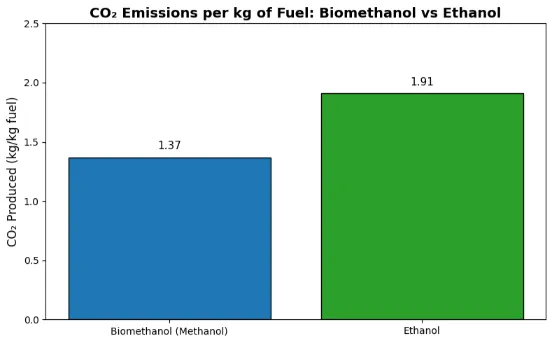
  • Greenhouse Gas Reduction: Biomethanol can cut greenhouse gas emissions by up to 90% compared to fossil-derived methanol.
  • Feedstock Flexibility: It can be made from non-food biomass and waste, which helps avoid land-use changes and food security issues.
  • Carbon Circularity: Advanced facilities are using carbon capture and utilization to make biomethanol with nearly zero carbon emissions.

Ethanol

  • Lower Carbon Footprint: Ethanol has a much lower carbon footprint than gasoline and produces fewer pollutants when burned.
  • Food vs. Fuel Debate: Most ethanol comes from food crops, which raises concerns about diverting resources from food production and increasing food prices.
  • Land and Water Use: Ethanol production needs a lot of arable land and water, which can strain resources and affect biodiversity.

Verdict: Biomethanol generally provides better environmental benefits, especially when made from waste or non-food biomass, leading to lower emissions and less resource competition.

Production and Feedstock: Circularity vs. Competition

Biomethanol

  • Feedstock: Uses agricultural residues, forestry waste, municipal solid waste, and captured CO₂, supporting a circular economy.
  • Technology: Produced through gasification and fermentation, with ongoing improvements in efficiency and carbon capture methods.
  • Scalability: Supply chains for feedstocks and conversion technologies are still being developed, but there’s strong potential for large-scale, sustainable production, particularly in areas with plenty of waste biomass.

Ethanol

  • Feedstock: Mainly produced from food crops (corn, sugarcane), with some growth in cellulosic ethanol using crop residues and grasses.
  • Technology: Established fermentation processes, but they are energy-intensive and sometimes use fossil fuels for processing.
  • Scalability: Well-established in major markets, but growth is limited by land, water, and food security issues.

Verdict: Biomethanol’s use of waste and non-food feedstocks gives it an advantage in sustainability and scalability, while ethanol’s production methods are more established and widespread.

Energy Efficiency and Performance

Biomethanol

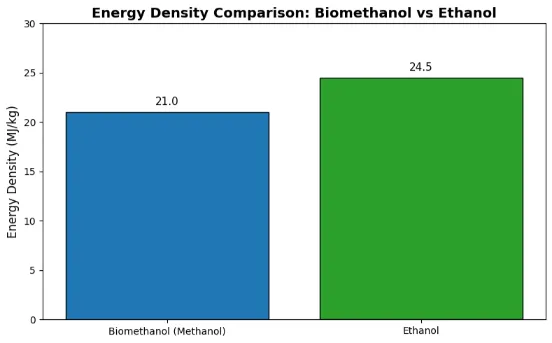
  • Energy Density: Higher than ethanol but lower than gasoline, making it a good choice for blending and direct use in modified engines.
  • Combustion: Provides cleaner combustion and reduces emissions of NOx and particulates, which is better for both vehicles and stationary power.
  • Infrastructure: Can be mixed with gasoline or used in methanol fuel cells and is compatible with existing storage and distribution systems.

Ethanol

  • Energy Density: Lower than both gasoline and methanol, which may reduce vehicle range unless engines are adjusted for ethanol.
  • Combustion: Burns cleaner than gasoline but can increase evaporative emissions; engine compatibility may be a challenge for higher blends.
  • Infrastructure: Commonly used as a gasoline additive (E10, E85), but high blends need engine modifications and specialized infrastructure.

Verdict: Biomethanol has a slight edge in energy density and flexibility, especially for next-generation engines and fuel cells.

Economic Factors: Cost, Investment, and Market Growth

Biomethanol

  • Cost-Competitive: As technology improves and waste feedstock supply chains develop, biomethanol is becoming more cost-competitive with fossil fuels and other renewables.
  • Market Growth: The global biomethanol market is expected to hit $9 billion by 2030, growing at a rate of 7% from 2023 to 2030.
  • Investment: Attracting significant investments, particularly in Europe and Asia-Pacific, where policies support low-carbon fuels and rapidly growing infrastructure.

Ethanol

  • Established Markets: Ethanol is already a multi-billion-dollar industry, especially in the US and Brazil.
  • Subsidies and Mandates: Its growth has been driven by government mandates and subsidies, but the sector faces more scrutiny over sustainability and resource use.
  • Price Volatility: Ethanol prices can fluctuate due to crop yields, weather changes, and commodity markets, leading to price uncertainty.

Verdict: Ethanol has the advantage of an established market, but biomethanol is quickly catching up as a scalable, sustainable, and economically viable alternative.

Applications: Where Do They Fit?

BAR CHART OF BIOMETHANOL ENERGY DENSITY

Biomethanol

  • Transportation: Used as a direct fuel, mixed with gasoline, or as a hydrogen carrier for fuel cell vehicles.
  • Industry: Serves as a feedstock for chemicals like formaldehyde and acetic acid, supporting greener manufacturing.
  • Power Generation: Used in methanol fuel cells for clean electricity production.
  • Marine and Aviation: Emerging as a low-carbon option for marine and aviation fuel, helping to decarbonize hard-to-reduce sectors.

Ethanol

  • Transportation: Commonly used as a gasoline additive or substitute, particularly in flex-fuel vehicles.
  • Industry: A feedstock for various chemicals, but less versatile compared to methanol derivatives.
  • Rural Development: Supports rural economies and creates jobs in agricultural areas.

Verdict: Biomethanol’s versatility across transport, industry, and power makes it a more adaptable option for the energy transition, while ethanol’s strength lies in established automotive markets.

Challenges and Limitations

Biomethanol

  • Feedstock Logistics: Large-scale production relies on reliable, sustainable supply chains, which are still not fully developed in many areas.
  • Conversion Technology: Ongoing research is needed to improve conversion efficiency and lower costs.
  • Policy Support: Needs strong policy frameworks and incentives to compete with established fossil fuels and ethanol subsidies.

Ethanol

  • Food vs. Fuel: Dependence on food crops raises ethical and economic issues, especially in regions facing food insecurity.
  • Land and Water Use: High resource needs can lead to deforestation, habitat loss, and water shortages.
  • Engine Compatibility: High ethanol blends can cause engine wear and require infrastructure upgrades.

Verdict: Both fuels face challenges, but biomethanol’s issues are more about technology and logistics, while ethanol’s are linked to resource conflict and environmental impact.

The Future Outlook: Which Fuel Holds the Key

Biomethanol
Driven by innovation, policy support, and the demand for truly sustainable fuels, biomethanol is set for rapid growth. Its ability to use waste feedstocks, cut greenhouse gas emissions by up to 90%, and fit into existing infrastructures makes it a strong candidate for the future of renewable energy. As more countries and companies invest in circular economy solutions, biomethanol’s role is expected to grow in transport, industry, and power generation.

Ethanol
Ethanol will continue to be an important part of the renewable fuel mix, especially in regions with established production and infrastructure. However, its long-term growth may be limited by resource challenges and sustainability issues. Advances in cellulosic ethanol and integration with other biofuels could improve its environmental profile, but competition for land and water will remain a concern.

Bar Chart of Biomethanol emissiions per Kg of Fuels

Conclusion: Biomethanol or Ethanol?

Both biomethanol and ethanol are crucial for the global energy transition, providing significant emissions reductions and supporting economic development. However, biomethanol’s adaptability, lower environmental impact, and fit with a circular economy make it a more promising option for a sustainable future. As technology improves and policies evolve, biomethanol is likely to become more central in decarbonizing transport, industry, and power—opening new pathways to a low-carbon world.

Related Reads on Biomethanol:

From Waste to Wonder: How Biomethanol Production is Transforming Agricultural Byproducts

Explore how agricultural waste is being turned into clean fuel through innovative biomethanol production.

The Biomethanol Advantage: How Small Businesses Are Cutting Emissions While Boosting Their Bottom Line

Discover how small businesses are saving money and going green with biomethanol solutions.

Biomethanol And Ethanol: Which Renewable Fuel Holds The Key To Our Future Read More »

india blending ethanol

India Accelerates Ethanol Blending to Boost Energy Independence

India Accelerates Ethanol Blending

India has made significant strides in ethanol blending over the years, reflecting its commitment to enhancing energy security and reducing carbon emissions. Since the inception of ethanol blending initiatives in 2001, the country has progressively increased its ethanol penetration, reaching a national average of 12% v/v in the 2022-2023 ethanol supply year. This growth is supported by the government’s policies, which include reducing the goods and services tax on fuel ethanol and providing financial assistance for expanding grain-based ethanol production facilities.

In response to growing ethanol demand, India has ramped up its production capacity. By 2023, the country achieved an ethanol production capacity of over 10.82 billion litres annually, significantly surpassing previous years. Despite these advancements, India’s ethanol production still trails its consumption, necessitating further investments to achieve future targets, such as the ambitious E20 mandate slated for 2025.

Comparatively, India’s ethanol blending policies are more stringent than Brazil’s, particularly regarding quality specifications like minimum octane numbers and maximum sulfur content. While Brazil leads with a higher blending mandate of up to 27.5% v/v, India’s focus on ultra-low sulfur fuels showcases its commitment to cleaner energy solutions. However, as a net importer of ethanol, India faces challenges in matching Brazil’s production and consumption levels.

Projections in Ethanol Blending

To address these challenges, India is encouraging the adoption of flex-fuel technology in the automotive sector. Automakers are beginning to introduce flex-fuel vehicles, with Toyota launching a pilot for a flex-fuel hybrid in 2022. This move aligns with India’s goal of increasing ethanol usage across the transportation sector, setting the stage for a more sustainable and self-reliant energy future.

Get more info

To get more info check out inspire.sgs.com
Also trending topic Heat wave warnings

India Accelerates Ethanol Blending to Boost Energy Independence Read More »